[Column] A thorough comparison of EV policies, subsidies, and charging infrastructure in five major Southeast Asian countries — Where Japanese companies are likely to invest
✅ Roughly speaking
- 🇹🇭 Thailand is under the "30@30" policy EV 3.5 Package (2024–2027) imposes a purchase subsidy of up to 100,000 baht and a requirement for domestic production of two (2026) 〜 three (2027) per imported car, which is considered to be the most structured manufacturing attraction measure in Southeast Asia.
- 🇮🇩 Indonesia Presidential Decree 55/2019 + 79/2023 + Minister of Finance Regulation 38/2023 We are reducing the VAT on passenger BEVs from 11% to 1% and are building an upstream 〜 downstream EV value chain armed with nickel resources.
- 🇲🇾 Malaysia CBU (finished vehicle import) EV duty-free will end in January 2026 We have made significant progress towards preferential treatment for CKD (local assembly) (until the end of 2027).
- 🇻🇳 🇸🇬 Vietnam waives registration fees Re-extended until the end of 2030 (Decree 202/2026), Singapore EEAI final year As we welcome this, the systems of both countries are divided into light and dark.
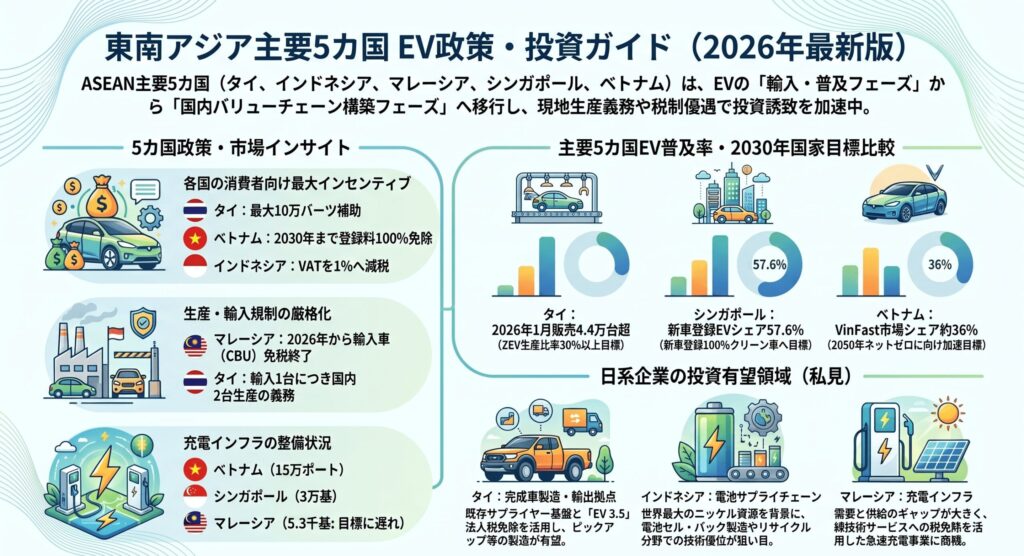
table of contents
Introduction
This time, we will be looking at electric vehicles (Electric Vehicles) from five major Southeast Asian countries: Malaysia, Indonesia, Singapore, Thailand, and Vietnam. Below we will explain the regulatory status of "EVs"), subsidies for EV companies, subsidies for consumers, and the implementation status of EV charging stations.
EV systems are particularly fast-paced, with major restructuring of national frameworks in late 2025 and early 2026.
I am increasingly receiving consultations from Japanese companies asking which sectors in which countries would be good for them to expand into the EV sector in ASEAN, and I would like to conclude this article by mentioning my own potential investment destinations.
To ensure the accuracy of the information, we rely on government agencies in each country and reliable primary sources for organization, but the system changes with each passing day, so when making actual investment decisions, we would appreciate it if you could check the latest official documents.
Malaysia — CBU preferential treatment ends, leading to an era of CKD as the only option
Regulatory framework
The core of Malaysia's EV policy is National Energy Transition Roadmap (National Energy Transition Roadmap). Hereinafter referred to as "NETR") , National Automotive Policy 2020 (National Automotive Policy). Hereinafter referred to as "NAP 2020") , Low Carbon Mobility Blueprint 2021–2030 (Low Carbon Mobility Blueprint. Hereinafter referred to as "LCMB") It is thought to be composed of three pillars.
NETR aims to decarbonize the transportation sector By 2050, EV penetration rate will be 80% and local EV manufacturing rate will be 90% The goal is set (Source: MIDA ).
The Ministry of Investment, Trade and Industry (Ministry of Investment, Trade and Industry) is responsible for this. Hereafter "MITI"), and below that National EV Task Force (NEVTF) and National EV Steering Committee (NEVSC) It appears that it is installed.
Incentives for businesses
Companies that assemble and manufacture EEVs (Energy Efficient Vehicles) against their statutory income (statutory income) 70% or 100% corporate income tax exemption for 5 or 10 years It is believed that there are systems in place to accept the offer (Source: The Investor ).
Companies that invest in green technology services such as the installation, maintenance, and repair of EV charging equipment, and the maintenance of EV infrastructure and charging stations, are welcome to 70% tax exemption for the first three years of operation applies.
In addition, Green Investment Tax Allowance (GITA) also offers a 100% investment tax credit over five years (Source: MIDA ).
Consumer Incentives and the Big Turnaround in 2026
2026 marked a major turning point.
Exemption from import duties and excise duties for CBU (Completely Built-Up) EVs will end on December 31, 2025 (Source: paultan.org ).
The Treasury has announced its revenue projections for 2026 at RM 12.79 billion, citing the end of EV incentives as one of the factors driving revenue growth.
The new tax structure for CBU EVs from January 2026 will differ depending on whether the country of origin has an FTA (Free Trade Agreement) with Malaysia Import duty 10 〜30%+ Excise tax 10% Sales service tax 10% , or Import duty 5% +excise tax 10%+ Sales service tax 10% It is likely that one of the following applies:
The price increase outlook from industry insiders is as follows:
- Francis Lee, CEO of Bermaz Auto (Xpeng distributor) Group. "Prices will rise by at least 20〜30%." .
- Roslan Abdullah, COO of GWM Malaysia (reported by Berita Harian). "Prices could rise by up to 100%." .
On the other hand, Tax incentives for CKD (Completely Knocked-Down) EVs will continue until the end of 2027 It will be done.
Proton has launched a dedicated EV factory in Tanjong Malim, and Perodua, Volvo and Mercedes-Benz are believed to already be assembling EVs on-site.
Consumers also have the following incentives:
- When an individual installs, rents, or purchases EV charging equipment at home or elsewhere, or when it comes to the contract fee for charging services, Annual income tax deduction of MYR 2,500 (Until 2027) (Source: The Investor ).
- For individuals earning up to MYR 120,000 per year, the maximum purchase price for electric motorcycles is required MYR 2,400 tax refund (2024 tax year) (Source: The Investor ).
Charging infrastructure development status
The government is based on the LCMB 10,000 public EV chargers by the end of 2025 The goal was to install Suruhanjaya Tenaga (Energy Committee). Hereinafter referred to as "ST") The number of licenses announced by as of the end of November 2025 is 5,360 units (AC 3,569 units + DC 1,791 units) It stayed there.
Malaysia Zero Emission Vehicle Association (MyZEVA) The achievement of 8,500 AC chargers is The situation will fall into the third quarter of 2026 (Source: paultan.org ).
Major charging operators (Charge Point Operators). Hereafter referred to as "CPO"), ChargEV, Gentari, JomCharge, Shell Recharge, etc. (Source: MIDA ).
ST will extend the review period for its Charging System License (EVCS) from the previous 60 days 30 days, essentially about two weeks We are also working to streamline administrative procedures, such as shortening the time to (Source: paultan.org ).
Market Data
The number of EV registrations in Malaysia in January 〜 August 2025 23,396 units (63.4% increase compared to the same period last year) (Source: SoyaCincau ), in the 2025 vehicle model rankings, 8,677 Proton e.MAS 7s They are ranked first, followed by the BYD Sealion 7 (4,454 units), Tesla Model Y (4,401 units), and BYD Atto 3 (Source: Automacha ).
The number of registrations in January 〜 May 2026 is 25,523 units (Up 83.99% year-on-year) and combined with rush demand before CBU tax increases, growth appears to be continuing (Source: SoyaCincau ).
Indonesia — Integration of Perpres regime and nickel strategy
Regulatory framework
Indonesia's EV acceleration policy is Executive Order 55/2019 (Perpres 55/2019) "Executive Order on Accelerating the Road Transport Program for Battery-Based Electric Vehicles" Based on and its revision Presidential Decree 79/2023 (Perpres 79/2023) , and Minister of Finance Regulation 38/2023 (PMK 38/2023) This is considered the core of practice (Source: ICCT ).
The government By 2030, the company will produce 2.5 million BEVs (battery electric vehicles) annually It is said to have set ambitious goals (Source: ICCT ) (Target values vary across the literature, so we recommend checking with the most recent official government values when publishing).
Local Procurement Requirements (TKDN)
What cannot be avoided when making investment decisions TKDN (Tingkat Komponen Dalam Negeri, domestic parts ratio) This is a requirement.
In the EV field 2019 〜 Over 35% in 2021, minimum 40% from 2022 onwards is required, and if this level is not reached, the use of incentives appears to be restricted (Source: Emerhub ).
The TKDN level is planned to be raised in stages.
Incentives for businesses
- Import tariff reductions and exemptions for foreign manufacturers committed to local production.
- Corporate income tax reduction (up to 15 years).
- Exemption from VAT on machinery imports.
Major manufacturers such as BYD, Wuling, Hyundai, and VinFast have already announced local production investments, and Indonesia The world's second-largest EV export growth from China in 2025 (Source: Ember ).
Consumer incentives
- VAT on passenger BEVs reduced from the standard 11% to 1% (PMK 38/2023, for vehicles above a certain TKDN level) (Source: ICCT ).
- Luxury Tax (PPnBM) Exemption for BEVs (Source: ICCT ).
- Subsidy for purchasing electric motorcycles Rp 7,000,000/unit (Starting in 2023). However, it will be suspended at the beginning of 2025 Scheduled to reopen in July 2026 (Source: Jakarta Globe ).
Charging infrastructure development status
Led by state-owned power company PLN SPKLU (Stasiun Pengisian Kendaraan Listrik Umum, Public EV Charging Station) is expanding.
2025〜 During the New Year's holiday transportation season in 2026, it will be in service areas on major highways 1,515 units was deployed on standby (this is the number of SA highway deployments during peak season, which is different from the total number installed nationwide) (Source: Gaikindo ).
In February 2026, a PLN-led consortium will open a fast charging station called "Zora Signature" in Tangerang province, Banten (Source: electrive.com ).
The SPKLU deployment appears to be designed around DC fast charging (50〜150kW).
Market Data
Indonesia's EV market penetration rate (BEV + PHEV) for the second quarter of 2025 is 15.2% It reached a peak, up from 10.1% in Q1 2025 (Source: ICCT Market Spotlight ). Quarterly sales volume Approximately 22,000 units , EV stock cumulative Over 100,000 units (Source: ICCT Market Spotlight ).
Electric bike market share to reach Q2 in 2024 Peak at 1.4% , then fell to 0.6% in Q4.
The impact of the suspension of subsidies can be seen in the trends (Source: ICCT Market Spotlight ).
Singapore — 2030 Last Spurt and EEAI Final Year
Regulatory framework
In Singapore Land Transport Authority (Land Transport Authority). Hereinafter referred to as "LTA") is in charge of and provides a clear timeline for (Source: LTA ).
- New diesel passenger car registrations will be suspended from 2025 .
- Starting in 2030, all new vehicle registrations will be limited to clean energy vehicles (electric, hybrid, and hydrogen fuel cells) .
EV Charging Act (EV Charging Act). Effective December 2023) Based on this, the following appears to be mandatory (Source: Ministry of Transport ).
- All chargers supplied must comply with LTA safety standards and be certified and registered.
- Charging service providers must obtain an LTA license and comply with requirements such as maintaining occupancy rates, taking out liability insurance, and sharing data.
- New and extensively renovated buildings are required to have a minimum number of chargers and electrical capacity.
- The voting requirement for installing chargers in condominiums has been reduced to 50%.
Technical standards Singapore Standard 722 (SS 722) has been in effect since April 1, 2026, replacing the previous TR25 (Source: Ministry of Transport ).
Consumer Incentives (EEAI Final Year)
- EV Early Adoption Incentive (EEAI) . For newly registered full EVs and taxis Additional Registration Fee (additional registration fee). 45% rebate from "ARF" below) . The rebate limit from January 1, 2026 to December 31, 2026 is SGD 7,500 . EEAI will be abolished from January 1, 2027 (Source: LTA ).
- Enhanced Vehicular Emissions Scheme (VES) . Band A rebates for passenger cars will be available in 2026 SGD 22,500 , 2027 SGD 20,000 It will be gradually reduced to (Source: LTA ).
- Electric passenger cars and taxis Reduce ARF floor to SGD 0 (Source: Ministry of Transport ).
- For commercial vehicles Commercial Vehicle Emissions Scheme (CVES) , for large vehicles Heavy Vehicle Zero Emissions Scheme (HVZES) and Electric Heavy Vehicle Charger Grant (EHVCG) It seems that is provided (Source: Ministry of Transport ).
Charging infrastructure development status
The government 60,000 units by 2030 The goal is to create (40,000 public parking lots and 20,000 private properties).
30,500 units as of March 2026 was introduced and exceeded half (Source: Business Today ).
Housing and Development Board (Housing Development Agency) Hereinafter referred to as "HDB") All housing complexes have already been designated "EV Ready," and charging points have been installed in over 90% of HDB parking lots. At least one fast charging hub in every HDB town by the end of 2027 We plan to install (Source: Ministry of Transport ).
For non-detached private homes EV Common Charger Grant will begin in July 2021, Until December 31, 2026, or until 3,500 grants are awarded We subsidize the cost of installing shared chargers (Source: Ministry of Transport ).
EV share of new car registrations in Q1 2026 57.6% (45% for the whole of 2025), and EVs are already the dominant market (Source: Business Today ).
Thailand — "30@30" policy and EV 3.5 package
Regulatory framework and the "30@30" target
Thailand Board of Investment (Investment Committee) Hereinafter referred to as "BOI") and National Electric Vehicle Policy Board (EV Policy Committee). Hereinafter referred to as "EV Board") is the core, and " 30@30 policy It holds up.
This is By 2030, ZEVs (Zero Emission Vehicles) will account for more than 30% of the country's gross domestic product (725,000 passenger cars and 675,000 motorcycles) The goal is (Source: BOI ).
EV 3.5 Package (2024–2027)
BOI approved EV 3.5 is a four-year comprehensive package from 2024 to 2027, succeeding EV 3.0 (2022–2023) (Source: BOI ).
Consumer purchase subsidy for passenger BEVs According to EY's commentary, (Source: EY ).
- The target is passenger BEVs priced at 2 million baht or less and with a battery capacity of 10 kWh or more.
- Battery capacity less than 10〜50kWh. 2024 THB 50,000, 2025 THB 35,000, 2026〜2027 THB 25,000 .
- Battery capacity of 50kWh or more. 2024 THB 100,000, 2025 THB 75,000, 2026〜2027 THB 50,000 .
- Subsidy recipients. BEV importers are in 2024 〜 2025, and domestic assemblers are in 2024 〜 2027.
Subsidies for electric pickups and electric motorcycles (domestic assembled vehicles only) is as follows (Source: EY ).
- Electric pickup (under 2 million baht, battery 50kWh or more, vehicle weight 4,000kg or less). THB 100,000 per vehicle (2024 〜2027).
- Electric motorcycle (under 150,000 baht, battery 3kWh or more). THB 10,000 per vehicle (2024 〜2027).
Tax incentives is as follows (Source: BOI , EY ).
- About passenger EVs priced under 7 million baht Excise tax reduced from 8% to 2% .
- For passenger EVs priced under 2 million baht imported via CBU, only in 2024〜2025 Import tariffs reduced by up to 40% .
- Excise tax on electric pickups will be 0% in 2024〜2025 and 2% from 2026 onwards.
- Excise tax on electric motorcycles will be reduced from 5% to 1%.
Local production obligation (Production Offset) are the most important features of this package (Source: BOI ).
- By December 2026, two imported CBUs will be produced domestically for every one imported CBU (1:2 ratio).
- By December 2027, three imported CBUs will be produced domestically for every one imported CBU (1:3 ratio).
- Localization of battery components will begin in 2026 It is necessary (Source: EY ).
From mid-2025, domestically produced EVs Export volume can also be counted towards fulfilling obligations The mitigation measures have been introduced (Source: ASEAN Briefing ).
The corporate income tax exemption for BOI-certified cases is up to eight years, with additional extensions possible depending on the activity code (Source: ASEAN Briefing ).
Charging infrastructure development status
Major CPOs EV Station PluZ (PTT series) , Elex by EGAT (Thailand Power Generation Corporation) , PEA VOLTA (Local Electric Power Company) , EA Anywhere , SHARGE It appears that the structure is led by government-affiliated power and oil companies.
The maintenance status is as of March 2025 Over 3,700 stations and 11,600 connectors (including over 6,000 DC fast charging) (Source: ASEAN Briefing ), and in another market tally Approximately 3,720 stations and 11,622 units The same level is shown (Source: TDL Service ).
Market Data
New BEV registrations in August 2025 11,486 units (Source: Thai Enquirer ), Sales in January 2026 were more than three times higher than the same month last year, with over 44,000 units sold (Source: Benchmark Minerals ).
With 15 companies participating in the EV 3 policy, it is believed that the entry of Chinese manufacturers in addition to existing Japanese manufacturers is accelerating (Source: BOI ).
Vietnam — VinFast and registration fee waiver extended in 2030
Regulatory framework
Vietnam's top frame of EV policy approved by Prime Minister in 2022 Decision 876/QD-TTg "Action Plan for Green Energy Transition and Carbon and Methane Emission Reduction in the Transport Sector" (Source: Vietnam Briefing ).
The changes in its subordinate laws are as follows:
- Decree 10/2022/ND-CP . BEVs are exempt from registration fees by 100% for the first three years, and reduced by 50% for the next two years (Source: Trade.gov ).
- Decree 51/2025/ND-CP (Promulgated March 1, 2025). 100% exemption from BEV registration fees Until February 28, 2027 Extension (Source: Vietnam Briefing ).
- Decree 202/2026/ND-CP ( Promulgated June 8, 2026, effective March 1, 2027 ). 100% exemption from BEV registration fees Until December 31, 2030 Re-extension (Source: Vietnam News , Vietnam Law Magazine ).
This extension until 2030 will provide foreign automakers with long-term policy predictability and is likely to be important in attracting FDI (Source: Vietnam Law Magazine ).
Consumer incentives
- 100% exemption from registration fee (Until December 31, 2030, Decree 202/2026) (Source: Vietnam News ).
- Special consumption tax for BEVs with 9 or fewer passengers reduced to 3% (Until February 28, 2027. It is expected to rise to 11% thereafter). Internal combustion engine vehicles in this category are taxed at 35〜150% depending on their displacement, so the preferential treatment is considered extremely large (Source: Tilleke & Gibbins ).
The Ministry of Finance also offers special consumption tax incentives Proposal to extend until 2030 The company has made this public, and future developments will be closely monitored (Source: Vietnam News ).
Incentives for businesses
The following is available for investors in EV manufacturing (Source: Tilleke & Gibbins ).
- Corporate income tax incentives (low tax rates, tax holidays, tax reductions).
- Exemption from import duties on imports intended for the creation or manufacture of fixed assets.
- Exemption from or reduction of land use fees, land rents, and land use taxes.
- Accelerated depreciation.
- Preferential electricity rates for public charging stations.
Official Letter No. 8685/VPCP-CN (2024) has clarified the expansion of charging infrastructure and the development of national technical standards as government policy (Source: Tilleke & Gibbins ).
Charging Infrastructure — V-Green's Success
Vingroup founder Pham Nhat Vuong has spun off from VinFast V-Green Global Charging Station Development JSC is leading the way.
- By the end of 2025, the company will complete a plan to develop 150,000 charging ports for passenger cars and motorcycles (Source: VIR ).
- March 2026, An additional US$400 million (VND 10 trillion) will be invested, and 99 ultra-fast charging hubs will be developed in 34 provinces by 2026 Announced plans to do so (Source: VIR ). Each hub appears to be equipped with up to 100 150kW fast chargers, ensuring a range equivalent to a full charge in 15 minutes.
- The hub is 100% renewable energy (wind and solar) and is manufactured by VinFast Battery Energy Storage Systems (BESS) The idea is to store and supply electricity to (Source: VIR ).
- 500,000 charging ports nationwide by 2028 The goal is to develop (Source: VIR ).
Other Singaporean Charge+ partners with Porsche to develop a 1,700km charging network between Hanoi and Ho Chi Minh City, and Grab Vietnam We are also working with (Source: VIR ).
Market Data
VinFast 175,099 EVs delivered in Vietnam in 2025 December broke the record for the highest monthly sales in Vietnam history with 27,649 units sold in a single month (Source: VinFast ).
VinFast ranks first in sales in Vietnam for 15 consecutive months By model, there are 44,585 VF 3s, 43,913 VF 5s, and 23,291 VF 6s (Source: VinFast ).
Market share for the whole of 2025 Approximately 36% It is estimated that it is the leading single brand in the Vietnamese automotive market (Source: technode ).
VinFast We operate 400 service workshops and over 150,000 charging ports in 34 provinces and cities It appears that the Vingroup group is responsible for both after-sales service and charging infrastructure (Source: VinFast ).
Summary of comparisons between 5 countries
| project | 🇲🇾 Malaysia | 🇮🇩 Indonesia | 🇸🇬 Singapore | 🇹🇭 Thailand | 🇻🇳 Vietnam |
|---|---|---|---|---|---|
| core policy | NETR, NAP 2020, LCMB | Perpres 55/2019・79/2023, PMK 38/2023 | LTA measures, EV Charging Act | 30@30, EV 3.5 (2024-2027) | Decision 876, Decree 202/2026 |
| National goals | 2050 EV 80% | 2.5 million BEVs produced in 2030 | All new cars in 2030 are clean | 30% of ZEV production in 2030 | Net Zero 2050 |
| Corporate tax system | 70-100% corporate tax exemption (5-10 years), GITA | Corporate tax reduction for up to 15 years | Project Individual | Corporate tax exemption up to 8 years + extension | Corporate tax incentives, land-related exemptions |
| Maximum consumer subsidy | CKD tax exemption, charging equipment RM 2,500 deduction | VAT 11%→1%, PPnBM exemption | ARF rebate maximum SGD 7,500 (2026 only) | Maximum THB for passenger cars: 100,000 units | 100% exemption from registration fee (until 2030), 3% special consumption tax |
| CBU import tax | Resurrected from January 2026 | TKDN linked | Ordinary tax | 2024-2025 down 40% | ICE-level taxation |
| Number of public chargers | 5,360 units (November 2025) | 1,515 high-speed SA vehicles deployed (during peak season, not total number) | 30,500 units (March 2026) | Approximately 3,720 stations and 11,622 units | V-Green has over 150,000 ports |
| 2030 charging target | 10,000 units (delayed achievement) | During large-scale expansion | 60,000 units | Continuation and expansion | 500,000 ports in 2028 |
| EV penetration rate | 23,396 units registered between January and August 2025 | 15.2% in Q2 2025 | 57.6% of new Q1 cars in 2026 | Over 44,000 units per month in January 2026 | VinFast market share: approximately 36% (2025) |
EV investment destinations for Japanese companies — My proposal
We have now organized the systems of each country, but now we will look at which countries and sectors are considered promising when Japanese companies consider EV-related investments.
I will summarize the following in my opinion.
Vehicle manufacturing: Thailand (passenger cars and electric pickups)
Thailand is affected by the following combined factors: It remains the leading investment destination for finished vehicle manufacturing That is what it seems.
- BOI EV 3.5 Exemption from corporate income tax for up to 8 years and exemption from machinery import duties.
- Clear national goals and long-term policy stability for the "30@30" policy.
- Existing automotive parts supplier base (ASEAN's largest automotive manufacturing hub).
- Export units can also be counted towards local production obligations The system is extremely advantageous for export bases within ASEAN and in Australia and Europe.
- The fact that subsidies are available for electric pickups seems to be a strong affinity with the areas that Japanese manufacturers excel at.
On the other hand, Chinese manufacturers (BYD, Great Wall, SAIC) and Taiwanese manufacturers are already making active investments, so if they enter the market late, it is likely that designing a differentiation strategy will be important.
Batteries and materials: Indonesia (upstream 〜 middle)
Indonesia The world's largest nickel-holding country As such, we have a strategic position that holds a key position upstream in the battery supply chain.
While TKDN requirements are a barrier, they are also considered attractive investment targets for the following reasons:
- Superior raw material procurement costs for nickel, cobalt, etc.
- By establishing a JV with local partners, it is possible to achieve both TKDN requirements and obtain subsidies.
- Within the government-led value chain integration (mining → smelting→ precursor →cathode →cell→ pack), Japanese companies, in particular, Battery cell pack manufacturing, battery management system (BMS), recycling It is believed that we can demonstrate technological superiority in this field.
- The fact that Honda, Mitsubishi Motors, and others already have a foothold in Indonesia could also be a positive factor in investment decisions.
Risks include a sharp increase in the TKDN ratio, concerns about policy predictability, and concerns about the consistency of legal enforcement.
Charging infrastructure: Malaysia (fast charging, residential and commercial facilities)
Malaysia is lagging behind in meeting its public EV charger targets Strategic shift from "quantity to quality" is reported to be happening (Source: Reccessary ).
On the other hand, it can be said that this country has the largest gap between market needs and supply.
- CKD EV preferential treatment continues (Until the end of 2027), domestic EV sales are expected to continue to grow.
- GITA offers a 70% tax exemption for green technology services for three years.
- There is likely to be significant room to utilize the technology and operational achievements of Japanese companies (such as Tokyo Electric Power Company's e-Mobility Power and Hitachi) in both the areas of DC fast charging along highway corridors and AC charging for commercial facilities such as shopping malls.
- It would also be worth considering an alliance with a local CPO such as ChargEV or Gentari, or even an M&A.
Commercial and heavy vehicle EVs: Singapore
Although Singapore has a limited market size, it is considered valuable as a "demonstration experiment and regional hub" for Japanese companies from the following perspectives:
- HVZES (Heavy Vehicle Zero Emissions Scheme) and EHVCG (Electric Heavy Vehicle Charger Grant) provides a subsidy facility specifically for electrifying large vehicles.
- There are clear plans to have fast charging hubs in all HDB towns by the end of 2027.
- High regulatory standards (such as SS 722) and an English-speaking business environment could serve as a stepping stone for technology exports to ASEAN countries.
- After the EEAI ends (2027〜, there is a risk of stagnation in the consumer EV market Commercial and heavy vehicles and B2B charging infrastructure, not personal passenger cars A strategy focused on this seems realistic.
Electric motorcycles and electric delivery: Vietnam (but be aware of competing risks)
Vietnam is in the midst of a VinFast oligopoly Direct competition in passenger four-wheel EVs is extremely fierce That is what it seems.
On the other hand, the following areas have potential:
- Electric motorcycle. Locally manufactured using existing presences of Yamaha and Honda.
- Electric delivery vehicle (Last Mile Delivery). B2B channels such as Grab Vietnam partnerships are the most popular.
- Battery Replacement (Battery Swap) Station . V-Green is also planned to be rolled out, but it is thought that there is room for multiple players to coexist in urban and rural areas.
- Supply to VinFast as a parts supplier.
Extension of registration fee exemption until 2030 by Decree 202/2026 This is a major signal that makes it easier to forecast long-term return on investment, and we believe that strategic consideration is effective when this opportunity is seized (Source: Vietnam Law Magazine ).
Overall ranking (just my opinion)
When broken down by sector and country, we believe that the investment priorities of Japanese companies are as follows:
- Thailand×Completed car manufacturing and parts . Medium- to long-term stability and export base capabilities.
- Indonesia ×Battery Upper and Middle Ages . Resource advantages and the possibility that TKDN support could turn barriers to entry into strengths.
- Malaysia × Charging Infrastructure . Gap markets, tax incentives, and affinity with Japanese technology.
- Singapore ×Commercial and large EVs . Actual evidence points, transparency of the legal system.
- Vietnam ×Electric motorcycles and parts supply . Areas must be selected that avoid competing risks.
summary
The EV policies of five Southeast Asian countries are From the "promotion phase with uniform subsidies" to the "system selection and maturation phase" It is believed that we are in the process of transitioning to this.
- Thailand's EV 3.5 and local production obligations, Indonesia's TKDN, and Malaysia's end of CBU preferential treatment are all "Shifting from import dependency to building domestic value chains" This is a clear signal.
- The end of the EEAI in Singapore and the extension by Decree 202/2026 in Vietnam until 2030 "Exit Strategy for Subsidies" This appears to illustrate the contrasting approaches taken by various countries.
- Charging infrastructure is divided into two categories: not meeting targets (Malaysia), oligopolistic (Vietnam), and achieving good results (Singapore).
For Japanese companies, "In which country, in which sector, and at what time" I get the impression that the design is more important than ever.
We believe it is essential to make investment decisions that determine the timing of institutional changes through primary sources in each country and dialogue with local governments.
- [Column Writing] 【ESG Strategies for Business 】Part 33: Current Location of Malaysia's Decarbonization Policy— NETR and National Emissions Trading Policy, Latest Review of the CCUS Act
- [Column Writing] 【 ESG Strategies for Business 】34th National Carbon Market Policy and ETS Initiative— How to Move from Voluntary to Compliance Markets
Related articles
-
 [Column Writing] 【 ESG Strategies for Business 】36th Malaysia's EPR Mandatory Packaging and Single-Use Plastic Regulations— Current Location of the Plastic Sustainability Roadmap
 -
[Column] Will Vietnam be the next Thailand – Footsteps of low birth rates and talent shortages
-
[Column] Can Japanese Hydroelectric Technology Be Used Abroad – From "Building" Power Plants to "Using them for a Long Time"
-
[Column] Can a corrupt country grow its economy – Quality of growth from the Philippines
-
[Column Writing] 【ESG Strategies for Business 】35th Malaysian PDPA Revision and Practical Responses for Japanese Companies— Guidelines for DPO Appointment, Disclosure Notification, and Cross-Border Data Transfer
-
[Column] Will Vietnam change ASEAN's growth pecking order. Semiconductor and human resource development advance the industry
-
[Column] Why Malaysia's semiconductor industry is being reevaluated now. Current location as the center of ASEAN restructuring
-
【Announcement 】 First report published as JETRO Platform Coordinator