
[Column] Can a corrupt country grow its economy – Quality of growth from the Philippines
✅ Roughly speaking
• 📈 Even in countries where corruption exists, economies can grow due to population growth, urbanization, foreign investment, etc.
•💰 However, corruption increases the burden on businesses, distorts the priorities and quality of public investment, and destroys growth that could have been achieved.
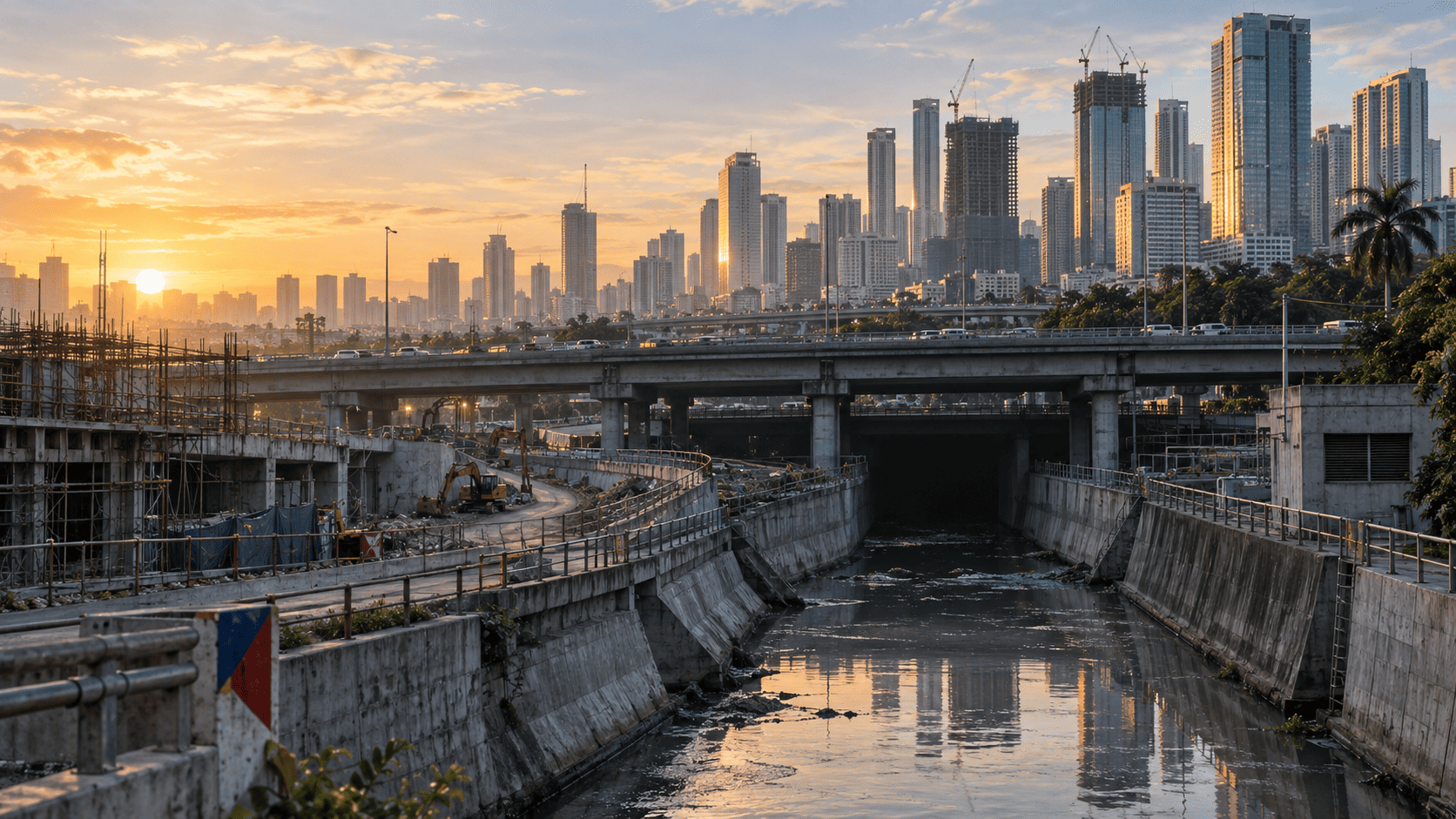
・🏗️ Allegations of fraud surrounding flood control and infrastructure projects will become a major issue in the Philippines in 2025, with implications for investment and financial management also being noted. Philippine Treasury Department 2026 Fiscal Risk Report However, the impact of the survey on public investment has been clarified.
•🔍 We need to look at not just the growth rate, but who is benefiting and who is bearing the costs and risks.
Table of Contents
Introduction
This time, we will use the Philippines as a starting point to explain the relationship between corruption and economic growth.
There are voices assessing the future of the Philippine economy, including its young population, English-speaking workforce, remittances from overseas workers, and the growth of the service industry.
In fact, real gross domestic product grew 5.7% in 2024 and 4.4% in 2025, according to the Philippine Statistics Authority. National Accounts published by the Philippine Statistics Authority You can check it here.
Real gross domestic product in 2025 will increase 4.4% year-on-year And there is no doubt that the economy continues to grow, even though it has slowed down.
On the other hand, the overall growth of the economy is not the same as the results that have led to improvements in people's lives and the development of competitive industries.
Even if roads and flood control facilities have large budgets, if they include projects that don't actually exist or low-quality construction, then book expenditures and the value society receives will not match.
Even if foreign companies enter the market, if they are required to make opaque payments regarding licenses and public procurement, the funds that would otherwise be used for investment will be lost.
Corruption is not just a matter of taking the money that is right in front of you.
It's a question of distorting which businesses are selected, which companies grow, and who receives the benefits of growth.
What does corruption mean
The World Bank has framed corruption as the abuse of public office for private gain. World Bank report on corruption and economic development In addition to bribery, the book also covers nepotism, theft of state assets, and misappropriation of public funds.
The word "corruption" generally conjures up images of politicians and civil servants receiving cash.
However, when considering the impact on the economy, we need to look at broader actions.
・Bribery to obtain a license
・Inflated orders for public works
・Fictional projects where no actual construction work is taking place
・Cohesion between politicians, bureaucrats, and corporations
- Nepotism that favors relatives and supporters
- Unfair profit-making using public land and assets of state-owned enterprises
These don't all harm the economy in the same way.
Some corruption directly burdens corporate activities, while others distort the allocation of the national budget for extended periods.
Therefore, it is not enough to simply rate a country as having "high corruption," but we need to look specifically at who is using which powers and what benefits they are gaining.
How corruption hinders economic growth
This will result in unpredictable additional costs for businesses
Bribery becomes a kind of additional cost for a company.
However, unlike regular taxes, the amount and payment date are not clearly defined.
There is no guarantee that the procedure will be completed once payment is made.
The International Monetary Fund explains that bribery acts like a particularly harmful tax on investment, reducing investment motivation. The International Monetary Fund's explanation of corruption and investment However, a negative relationship is believed to be found between corruption and investment and economic growth.
For foreign companies, even if locally paid money is acceptable as a practice in their new location, it may still violate their own country's regulations on bribery of foreign public officials.
Therefore, in markets with a high risk of corruption, not only is there a risk of legal violations, but costs such as investigations, contract management, and employee training are also likely to increase.
Lose fair competition
When corruption spreads, companies with strong relationships with those in power are more likely to be chosen than those that offer superior technology or pricing.
Companies will also start using their funds to build relationships with politicians and bureaucrats, rather than for product development or human resource development.
In economics, rent-seeking is the act of seeking to profit from existing institutions and powers rather than creating new value in this way.
If human resources and capital shift from production activities to rent-seeking, long-term productivity is likely to decline, even if it does not immediately appear in gross domestic product figures.
Distort public investment priorities
In a corrupt government, the business that is most likely to benefit those involved may be chosen rather than the business that is most necessary for the people.
New, larger facilities may have larger contract amounts and be easier to allocate profits through orders and subcontracting than school repairs or existing road maintenance.
As a result, a phenomenon occurs where public investment increases, but the quality of infrastructure necessary for daily life does not improve.
International Monetary Fund research points to pathways where corruption increases public investment while reducing its productivity, negatively impacting government revenue, maintenance costs, and infrastructure quality. The International Monetary Fund's "Corruption, Public Investment, and Growth" This is explained in detail below.
Weakening trust in the government
If citizens start to believe that even if they pay taxes, some of their money will be diverted, it will become difficult for them to obtain cooperation in paying taxes.
If the price and necessity of public works projects are not trusted, it becomes difficult to gain support for the tax increases and infrastructure investments that are truly needed.
Corruption is not limited to losses in individual businesses, but is also thought to weaken the government's ability to implement future policies.
Nevertheless, the reason why corrupt countries grow
It's important to note that the presence of corruption does not immediately halt economic growth.
As populations grow, urbanization progresses, and foreign companies establish factories and service centers, even countries plagued by corruption will see an increase in their gross domestic product.
Rising natural resource prices and remittances from citizens working abroad can also support the economy.
Furthermore, certain industries or regions may only be linked to the international market and grow independently of the overall administrative issues.
Therefore, we cannot conclude that corruption does not affect the economy by comparing only short-term growth rates.
Losses from corruption can manifest as a difference between the actual growth rate and the growth rate that could have been achieved.
Even if the gross domestic product had increased by 5%, if the system had been fair, more investment and jobs could have been achieved.
However, accurately measuring this lost growth is not easy.
This is because corruption hinders growth, while low income and weak administrative capacity also contribute to the opposite relationship.
Therefore, it is necessary to avoid making definitive causal relationships between individual countries based solely on the correlation between corruption and low growth.
Quality of growth from the perspective of the Philippines
The potential for growth is great
The International Monetary Fund assesses the Philippines as having significant demographic growth potential and abundant natural resources.
At the same time, it is pointed out that reducing infrastructure disparities, promoting foreign direct investment, and strengthening governance and the rule of law are crucial for sustainable and inclusive growth. International Monetary Fund's 2025 Philippine Article IV Consultations It is shown in.
This is not a pessimistic assessment of the Philippine economy.
Rather, because we have the conditions to grow, institutional issues that hinder that potential become important.
Problems with flood control projects
In the Philippines, in 2025, allegations of fictitious or quality-related projects regarding public infrastructure, including flood control projects, became a major social issue. Announcement by the Philippine Presidential Office However, allegations of fraud and misappropriation of public funds in flood control and infrastructure projects over the past decade have been the subject of extensive investigation.
In September of the same year, the Independent Commission for Infrastructure, or Independent Infrastructure Commission, was established to investigate irregularities in flood control and infrastructure operations over the past decade. Announcement of the establishment of the committee by the Philippine Presidential Office The subject and purpose of the study are explained below.
However, corruption was not confirmed in all of the businesses investigated.
The legal liability of individuals and companies must be determined based on evidence and prescribed procedures.
Nevertheless, this issue provides material for concrete consideration of the relationship between corruption and economic growth.
Flood control facilities are not just facilities that look good once completed.
It is the foundation for protecting residents' lives, homes, business facilities, and logistics networks from typhoons and heavy rains.
If construction work does not actually take place or fails to meet the required quality standards, the public will bear a double burden: loss of public funds and damage from disasters.
The Philippine Treasury Department's 2026 Fiscal Risk Report also outlines how investigations into flood control projects have stalled payment reviews and public investment, creating medium- to long-term risks to infrastructure spending targets. Philippine Treasury Department Fiscal Risks Statement You can check it here.
There are two ways in which corruption can harm the economy.
One is that fraudulent construction results in the loss of public funds and infrastructure functions.
Another issue is that after fraud is discovered, the review and spending process stops, delaying the implementation of a proper project.
If preventative measures are weak, fraud will spread, and if the problem is discovered and then shut down en masse, economic activity will cool down, which is difficult.
What is needed is not to stop public investment, but rather to make procurement information public, verify the actual ownership, check on-site progress, and conduct independent audits effective from peacetime.
Don't explain the Philippines' problems solely through corruption
The challenges facing the Philippine economy are due to a variety of factors, including a slowdown in the global economy, uncertainty in trade policy, natural disasters, industrial structure, food prices, and regional disparities.
Declining growth rate in 2025 And corruption isn't the only cause.
The International Monetary Fund cites several downside factors, including the external trade environment, as well as slowing fixed capital formation and personal consumption, and climate disasters. International Monetary Fund's assessment of the Philippine economy But the causes are organized in a complex way.
Corruption is not the only cause that explains all of the Philippines' economic problems.
I think it's appropriate to view this as one of the factors that exacerbates existing infrastructure shortages, disaster risks, and income inequality, making it difficult for governments to make improvements.
Indonesian high-speed rail as another example of ASEAN
When considering the relationship between corruption and large-scale infrastructure, Indonesia's Jakarta-Bandung High-Speed Railway is also a useful reference.
In this project, proposals from Japan and China were compared, and ultimately, a project with China was selected.
At the time, the Indonesian government explained that the reason for its selection was that the Japanese proposal required government guarantees and the use of national budgets for land acquisition, while the Chinese proposal was an inter-company transaction method that did not require national budgets or government guarantees. Explanation of the selection process by the Indonesian National Secretariat You can check it here.
Subsequently, due to the overspending on project costs, the government changed the system to one that provides investment and support to the national railway company.
Indonesia's Audit Office reports that changes in funding methods have forced the government to invest 4.3 trillion rupiah in the state-owned railway company. Indonesia's Court of Audit's Audit Results for the 2021 Central Government Financial Report It is listed there.
Furthermore, the Indonesian Anti-Corruption Commission is continuing its preliminary investigation into corruption allegations surrounding the project.
However, as of May 2026, the investigation is still in the preliminary stage and has not determined the existence of corruption or the responsibility of those involved. Report on the investigation status by Indonesian state-run news agency ANTARA But that point is clearly stated.
This case does not immediately lead us to conclude that the change from Japan to China was due to corruption.
Furthermore, the mere fact that the expenses were exceeded does not justify the claim that there was any improper inflating.
Even legitimate projects can incur increased costs due to factors such as geological conditions, land acquisition, design changes, and construction delays.
On the other hand, since the key reason for the selection was not to create a government burden, I believe that the premise should be examined to determine why that premise was violated and who assumed the additional burden.
This issue is not limited to the China case.
Even when orders are placed by Japanese, European, American, or local companies, the same problem can occur if contract changes and risk sharing are unclear.
Things that cannot be seen by growth rate alone
Gross domestic product is an important indicator for measuring the added value of goods and services produced domestically.
But those numbers alone don't tell us who the benefits of growth were distributed to.
Spending on large-scale public works projects can boost gross domestic product during construction.
Even so, if there are few users, maintenance costs are high, and the public bears the burden of debt repayment for a long period, it does not necessarily mean that it is a successful investment for society as a whole.
To see the quality of growth, you need to look at at least the following:
- Whether the public works project is actually completed and has the required quality
- Who is in charge of the contract in case of cost overruns
- Whether the number of users and economic impact predictions were realistic
・The selection of businesses and contract changes have been made public
- Whether there are fair opportunities for entry for small and medium-sized enterprises and foreign companies
- Profits are not concentrated only on a few companies and politicians
- Whether debt and maintenance costs have been postponed to future generations
The World Bank's Worldwide Governance Indicators organize government effectiveness, regulatory quality, the rule of law, and corruption control as distinct aspects of governance. World Bank's Worldwide Governance Indicators As shown, growth is linked not only to corruption but also to the ability of the administration to design and implement policies.
It is important not only to increase the number of arrests, but also to establish a system that prevents fraud from occurring in the first place and ensures that proper business operations do not stagnate.
What Japanese companies should check in ASEAN
In my work related to ASEAN, I believe that corruption risk should not be viewed as a cultural issue of a particular country.
The problem lies not in a particular national character, but in the mechanisms of authority, interests, and oversight.
When Japanese companies move into the area, problems can arise through agents, consultants, joint ventures or subcontractors, even if the company does not directly pay money to civil servants.
In practice, you should check the following points:
- There are reasonable reasons to use an agent or consultant
- Whether the amount of compensation is balanced with the work provided
- The terms of success fee payment are clear
- Confirmed the relationship with the other party's beneficial owner or government officials
- Record communications and payments related to licenses and public procurement
- Whether the contract contains provisions regarding anti-bribery, auditing, and termination
- Whether there is a consultation point for employees who receive inappropriate requests
Simply creating regulations to prevent bribery is not enough.
It is necessary to understand the actual payments, referrals, entertainment, and interactions with government agencies that take place on-site, and to keep records that can be explained to third parties later.
Summary
Even in countries with corruption, the economy grows.
This is because population growth, urbanization, foreign investment, resource exports, and remittances from abroad can sometimes outweigh the losses caused by corruption.
However, the fact that it is growing does not mean that corruption is not economically harmful.
Corruption increases the burden on businesses, undermines fair competition, and distorts the priorities and quality of public investment.
The impact is likely to manifest not as an immediate halt to growth, but rather as a loss of growth that could have been achieved and a concentration of growth benefits on some areas.
While the Philippines has great growth potential, its issues surrounding flood control and infrastructure projects demonstrate the importance of not only quantity but also quality and transparency in public investment.
However, it is not appropriate to explain the Philippines' economic challenges solely through corruption, nor to treat the allegations under investigation as confirmed facts.
The key is to separate the confirmed facts from the allegations and then examine the flow of decisions, contracts, payments and burdens.
Whether a country has become wealthy cannot be judged solely by the number of roads and railways it has completed.
We need to see who benefits, who pays the costs, and whether the business will create value for society in the future.
Considering corruption is not just about discussing the ethics of politicians and bureaucrats.
I think it's about considering whether a country can allocate its limited funds and human resources to places where society truly needs them.
Related Articles
-
 [Column Writing] 【ESG Strategies for Business 】35th Malaysian PDPA Revision and Practical Responses for Japanese Companies— Guidelines for DPO Appointment, Disclosure Notification, and Cross-Border Data Transfer
 -
[Column] Will Vietnam change ASEAN's growth pecking order. Semiconductor and human resource development advance the industry
-
[Column] Why Malaysia's semiconductor industry is being reevaluated now. Current location as the center of ASEAN restructuring
-
【Announcement 】 First report published as JETRO Platform Coordinator
-
[Column] Commonalities among companies that fail in emerging markets. How to go beyond ordering products, entrusting agencies, and managing employees
-
[Column Writing] 【 ESG Strategies for Business 】34th National Carbon Market Policy and ETS Initiative— How to Move from Voluntary to Compliance Markets
-
[Column] A thorough comparison of EV policies, subsidies, and charging infrastructure in five major Southeast Asian countries — Where Japanese companies are likely to invest
-
[Column Writing] 【ESG Strategies for Business 】Part 33: Current Location of Malaysia's Decarbonization Policy— NETR and National Emissions Trading Policy, Latest Review of the CCUS Act