[Column] AI boom will drive up electricity prices in Malaysia: The practical application of the "green electricity battle" that began behind the surge in data centers
[Column] AI boom will drive up electricity prices in Malaysia: The practical application of the "green electricity battle" that began behind the surge in data centers
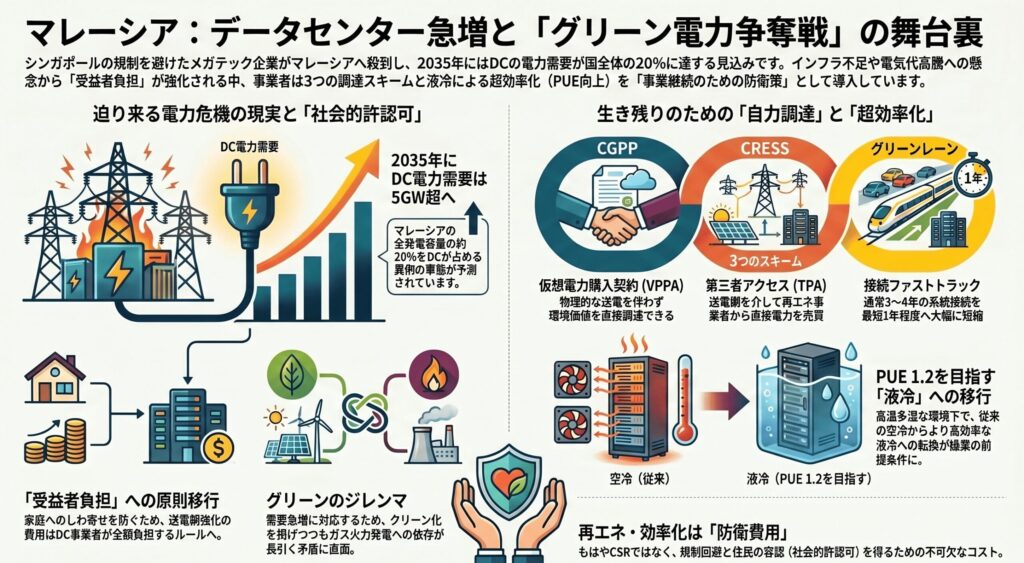
🏭 As megatech companies evade Singapore's regulations and flood Johor and Klang Valley, Malaysia's data center (DC) electricity demand is predicted to exceed 5 GW in 2035
⚡ National power company TNB is investing heavily in the grid, but is facing a "green dilemma" as the growth in demand for power and cooling for its AI servers outpaces it, leading to a prolonged reliance on gas-fired power plants
🌱 DC operators are rushing to "self-sourcing" green electricity in Malaysia using three practical schemes: CGPP, CRESS and Green Lane
🛡️ We believe that renewable energy procurement and ultra-efficiency are no longer CSR but are becoming "business continuity costs (defense costs) to continue operating in Malaysia."
This time, we will discuss Malaysia's burgeoning AI data centers and the "battle for green electricity" that is intensifying behind the scenes.
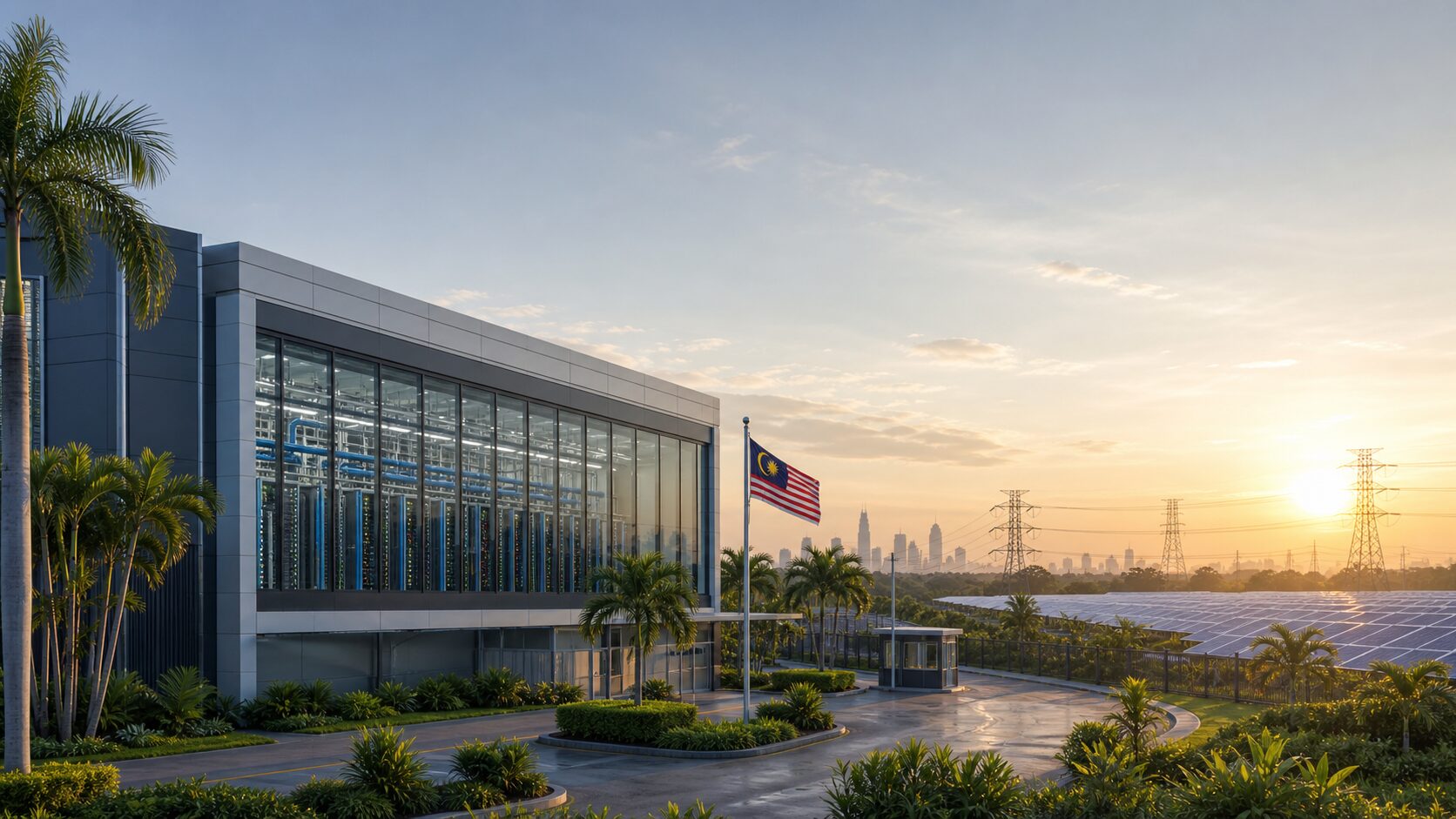
In Johor and the Klang Valley near Kuala Lumpur, there is currently a rush to build empty data centers (Data Centers, hereinafter referred to as "DCs"). This is because megatech companies are moving their bases to Malaysia in a move to avoid the strict land and electricity regulations of neighboring Singapore. While it is a welcome investment "light," the infrastructure "shadow" of where the vast amounts of electricity and cooling water will come from is also rapidly deepening.
I am a lawyer in Japan and a manager of a local corporation in the renewable energy sector, and I am following the Malaysian electricity system in practice, but the rules in this field have changed significantly in the last year or two. In this paper, I would like to review the supply and demand realities and then organize the specific systems that DC operators use to ensure green electricity and the "social licensing" issues behind them.
Why DCs are flocking to Malaysia — The starting point of "Singapore's Shadow"
As a result, Malaysia, particularly Johor, became a receptacle for demand that had lost its way. According to the Malaysian government, Between 2021 and June 2025, 143 DC projects were approved, with investments of approximately 144.4 billion ringgit . The Johor-Singapore Special Economic Zone (JS-SEZ) will also be officially established in January 2025, further accelerating the accumulation of DCs across the two countries. This is considered a typical example of how "regulatory differences" are driving investment flows within the ASEAN region.
The question is where on earth they're going to get all this "electricity" and cooling "water" and who's going to pay for it. There are real concerns that if AI companies use up the country's infrastructure, ordinary households and other industries will experience a "wrinkle" in the form of rising electricity prices.
However, there is a significant gap between the actual demand at the foot of the problem and the "application-based demand." According to Energy Committee data presented to Parliament in November 2025 by the then Deputy Minister of Investment, Trade and Industry: As of June 2025, DC's actual consumption was only 603 MW, which is only about 47% of the declared maximum demand of 1,276 MW . Concerns about speculative applications and the rise of "stranded assets" (stranded assets) have reportedly led the government to ask DCs to increase their occupancy rates to 85% of declared demand. This discrepancy is thought to make planning difficult, as the power grid is forced to plan based on "the amount declared to be used in the future" rather than "the amount used now."
Another type of permission called "social permission"
It is important to emphasize here that DC operators are no longer just concerned with "legal permits" for land and electricity.
I believe the days of "paying for land and electricity" are already coming to an end. If local residents and other industries see us as "a force that takes away our infrastructure and increases our electricity bills," governments will be forced to impose strict regulations, such as limiting electricity quotas and imposing penalties. This is a concept called social license to operate (Social License), which refers to the "acceptance" implicitly given by society to continue a business, separate from legal permits.
This means that securing and increasing the efficiency of green electricity is also becoming a condition for avoiding criticism from residents and other industries and maintaining "social permission" to operate.
Three practical schemes for "self-procuring" green electricity
To deflect criticism from local communities and at the same time achieve the Global Headquarters' Scope 2 (indirect emissions derived from electricity purchased by operators) reduction targets, DC operators are scrambling to "enclose" green electricity within Malaysia. The three systems that serve as means to achieve this are as follows:
CGPP (Corporate Green Power Programme)
CGPP is a system in which a company (offtaker) enters into a virtual power purchase agreement (VPPA) with a solar power provider. It is unique in that companies purchase the environmental value of re-energy without physically handing over electricity. It was launched in 2022 with a total capacity of 800 MW (maximum per operator of 30 MW) . The CRESS described below was introduced as a successor system to expand and liberalize the CGPP, which had filled this framework.
However, the premise for receiving these preferential treatments tends to be a need for high levels of energy efficiency, which leads to the following point.
"Buy" isn't enough — The defense of ultra-efficiency (PUE)
Securing green electricity is not enough on its own. At the same time, the question is efficiency: how to run and cool the server with less power.
In this respect, Malaysia's hot and humid climate is a major handicap. High temperatures and extremely high humidity throughout the year can easily reduce the efficiency of conventional air conditioning and evaporative cooling. According to local reports, the PUE for a typical Malaysian DC is around 1.4〜1.8, but the new DC that has introduced liquid cooling aims for around 1.2 . The transition from air cooling (Air Cooling) to more efficient liquid cooling (Liquid Cooling) is likely becoming a de facto prerequisite for new DCs. Malaysia's planning guidelines also emphasize efficiency standards such as PUE and early consultation with TNB, and it appears that efficiency is shifting from being a "recommendation" to being a "requirement."
summary
As we have seen, green electricity procurement and ultra-efficiency in Malaysia is no longer an effort to promote corporate social responsibility (CSR). I believe this is changing the nature of the business to a "business continuity cost," a defense cost, in a sense, in order to continue operating in Malaysia while avoiding friction with residents and other industries, and avoiding government regulations and penalties.
The days of simply "paying to buy electricity" are over. Going forward, companies that cannot secure green electricity for themselves and are unable to go into efficiency improvements will likely be effectively shut out of the Malaysian market or continue to pay the rising costs and fees of grid strengthening. Designing how to combine systems such as CGPP, CRESS and Green Lane, and who will bear the costs at what stage, has already become a central theme in legal and contractual practice.
Malaysia's rapid institutional design within ASEAN appears to be a precedent that will be useful for other countries in the region. For companies considering entering the market or investing in DC, we hope this article will help them gain a comprehensive overview of the entire system.