[Column] Malaysia's Large-Scale Solar Power Plant (LSS) to require battery energy storage (BESS) installation from next bidding – Read about the impact on investment and M&A practices
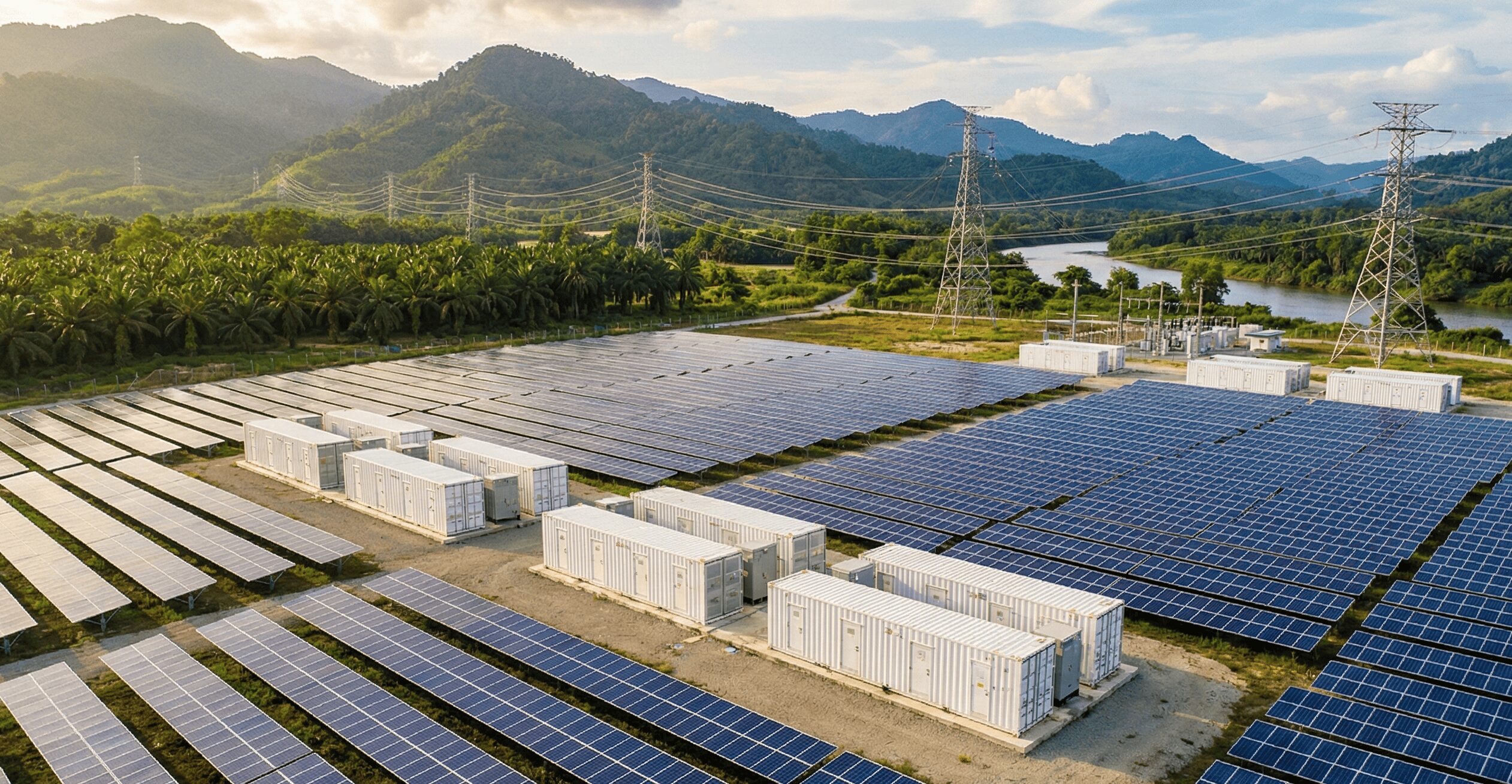
✅ Roughly speaking
🌞 Fundamental changes to the next LSS bidding process: The government has announced that the installation of BESS (Battery Energy Storage Systems) will be a mandatory requirement for large-scale solar power generation projects in order to improve grid reliability.♻️ Disposal regulations directly impact exit strategies: EPC contractors will be required to develop procedures for dismantling, decommissioning, disposal, and recycling batteries, and will be required to comply with regulations such as the Environmental Quality Act.🛡️ Compliance with international safety standards: To reduce the risk of fire and explosion, compliance with international safety standards such as NFPA 855, IEC 62619, and UL 9540 will be required.💼 Financial model restructuring required: Increased CAPEX, decommissioning provisions, revised insurance terms, and scrutiny of long-term O&M costs will be prerequisites for investment decisions and valuations.
✅ Audio summary of this post here
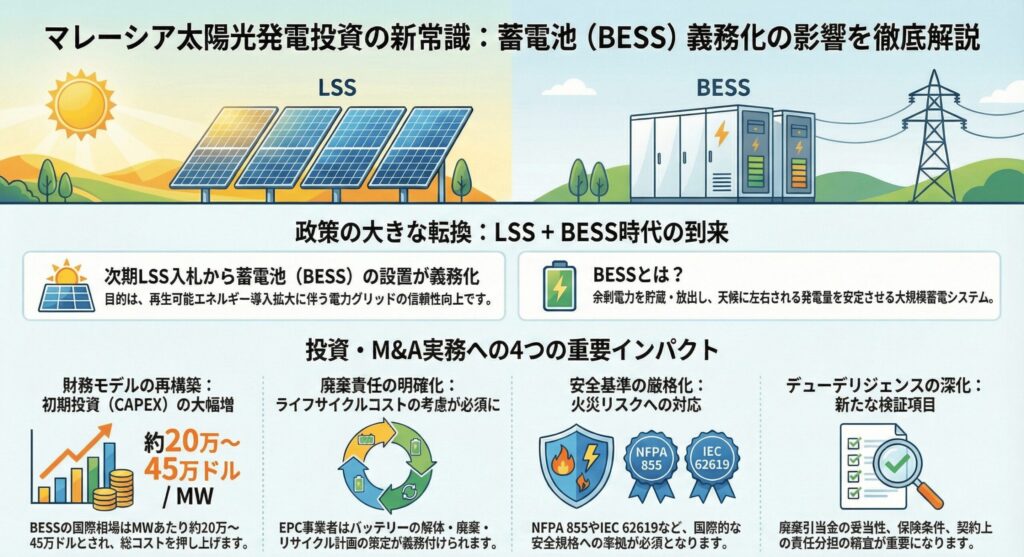
table of contents
Introduction
The Edge, a leading Malaysian economic newspaper, reported on a major policy shift in the country's energy policy in its CEO Morning Brief dated December 4, 2025 .
This article will explain this report from the perspective of investment and M&A practices.
Anyone involved in M&A or project development in Malaysia is likely well aware of the strong appetite for investment in the country's renewable energy market, particularly in LSS (Large Scale Solar) projects.
However, on December 3, 2025, during a question and answer session in the Malaysian House of Representatives (Dewan Rakyat), Deputy Minister of Energy and Water Transformation Akmal Nasrullah Mohd Nasir outlined an important policy that could impact future investment models and, ultimately, valuations.
That is, " Installation of battery energy storage systems (BESS) will be made mandatory in the next LSS bidding ."
This should not be seen as simply adding more equipment.
This appears to be a change that will require a fundamental restructuring of the financial model, including the project's CAPEX (capital expenditures), OPEX (operating expenses), and even disposal costs at the time of exit.
This article delves deeper into this policy change from a business and transactional perspective.
Background of the policy change: Implications of mandatory BESS installation in LSS
Policy shift towards grid stabilization
Up until now, Malaysia's LSS projects have focused primarily on "expanding the amount of power generation" by generating electricity at low cost and connecting it to the grid.
However, Deputy Minister Akmal made clear in the House of Representatives that the government intends to make the installation of BESS a requirement in the next LSS tender "to enhance grid reliability."
To quote the Deputy Minister, "When we implement the next LSS, we envisage that these projects will be accompanied by or require the installation of BESS."
A BESS (Battery Energy Storage System) is a large-scale battery system that stores surplus energy and releases it when needed, ensuring a stable energy supply.
As the proportion of renewable energy introduced increases, it seems that adjustment capabilities (BESS) have become essential to absorb output fluctuations due to weather and maintain a stable supply.
This is a typical maturation process that has been seen in other leading renewable energy markets in other countries.
Ongoing related projects and market trends
This move is not believed to be sudden.
In fact, the deputy minister said that a pilot BESS project being developed by state-owned power utility Tenaga Nasional Bhd (TNB) is currently in the construction phase and is expected to be operational by the end of 2026.
Additionally, the Energy Commission (EC) has already launched a public bidding for the Malaysia Battery Energy Storage Technology (MyBEST) for a utility-level BESS capacity of 400MW/1,600MWh, and has completed evaluation and is awaiting approval from the Ministry of Finance (MOF).
The results are expected to be announced soon.
In other words, it appears that the Malaysian government has fully transitioned to a phase of promoting "renewable energy + storage batteries" as a set, and it is expected that future LSS projects will require the formulation of business plans that assume the introduction of BESS.
Impact on investment and M&A practices ①: Life cycle costs and disposal liability
Legal framework for waste and recycling regulations
Investors and M&A players should pay particular attention to the concept of "life cycle costs" associated with the introduction of BESS.
The Vice Minister stated that the following strict protective measures will be taken to prevent waste batteries from becoming an environmental problem:
The new requirements require EPC (Engineering, Procurement and Construction) companies to outline the following steps:
- Dismantling
- Decommissioning
- Disposal
- Recycling
The Deputy Minister explained that these procedures must be in line with local laws, particularly the Environmental Quality Act and the Solid Waste and Public Cleansing Management Act 2007.
It also states that the implementation of environmental management plans and mandatory recycling of battery components will become mandatory.
Practical Issues in Due Diligence (DD)
In M&A due diligence practice, important verification items are considered to be whether the target company or project properly understands and responds to the following points.
Items to be confirmed in financial due diligence
-
Accuracy of waste disposal cost estimates
- Identifying the timing of disposal based on the expected lifespan of the battery (internationally, the lifespan of utility-scale lithium-ion batteries is generally considered to be 10 to 15 years)
- The validity of the calculation basis for dismantling, transportation and recycling costs
- Provisions recorded (appropriate accounting expense recognition)
-
Contractual Allocation of Liability
- Clear provisions for disposal liability in EPC contracts
- Scope of long-term maintenance responsibility in O&M (Operation and Maintenance) contracts
- Clarifying risk allocation between sponsors (investors) and EPC operators
-
Regulatory Compliance
- Ensuring compliance with the Environmental Quality Act and Solid Waste Management Act
- Status of Environmental Management Plan formulation
- Selection criteria for recycling companies and license status
Items to check in legal due diligence
- Status of disposal obligations specified in project contracts
- Status of approval of disposal plan in environmental permit
- Does the company have clauses to deal with the risk of future legal changes (such as change in law clauses)?
In particular, taking into account the risk that the cost burden at the time of disposal will increase more than expected, it seems practically advisable to allow for a certain margin as a contingency (contingent liabilities/expenses for dealing with unforeseen circumstances).
Impact on investment and M&A practices ②: Safety standards and risk management
Obligation to comply with international safety standards
One of the biggest risks when introducing BESS is fire.
In South Korea, more than 20 fire accidents involving energy storage systems (ESS) occurred between 2017 and 2019, causing a major problem.
In fact, BESSs that use lithium-ion batteries have inherent fire risks due to overcharging, thermal runaway, and cell imbalance.
The Malaysian government also takes this issue seriously, and according to the Deputy Minister, they intend to make compliance with the following safety standards mandatory:
- NFPA 855 : National Fire Protection Association standard for the installation and operation of energy storage systems
- IEC 62619 : International standard for industrial lithium-ion battery safety established by the International Electrotechnical Commission
- UL 9540 : Underwriters Laboratories safety standard for energy storage systems and equipment
These are required to meet the requirements of the Malaysian Fire and Rescue Department and are intended to minimise the risk of fire or explosion.
Practical points for contract negotiations and insurance coverage
In practice, the following points are considered to be important points in contract negotiations and insurance coverage:
Examples of provisions to be considered in EPC contracts
[BESS equipment compliance with safety standards (example)] 1. The supplied BESS equipment must have the following certifications: - NFPA 855 Compliance Certificate - IEC 62619 Certification - UL 9540 Certification 2. The EPC contractor must report to and obtain approval from the Fire and Rescue Department at their own responsibility and expense. 3. The procedure to be followed in the event that certification cannot be obtained must be clearly stated.
Issues to consider when purchasing insurance
-
Property Insurance
- Consideration of special clauses to cover damage caused by fire at BESS facilities
- Check the scope of exclusions in the disclaimer
- Setting an appropriate insurance amount
-
Liability Insurance
- Response to liability for damages to third parties due to the BESS fire
- Confirmation of scope of compensation for environmental pollution
- Appropriate setting of insurance amount
-
Delay in Start-Up Insurance (DSU)
- Responding to the impact of delays in delivery of BESS equipment
- Waiting Period Settings
A practical approach to contract negotiations
In M&A negotiations, the following division of responsibilities is expected to become a point of contention between the seller and buyer:
- Example of seller's argument : "We have obtained the currently available certification, and the buyer should bear the costs of future regulatory changes."
- Example of buyer's argument : "The seller should bear the cost of upgrades if the property does not meet the standards required by the Malaysian authorities."
In this regard, it may be possible to include appropriate provisions in the representations and warranties clause.
Impact on financial models and valuation practices
CAPEX impact
The addition of the BESS equipment is expected to significantly increase the project's capital expenditure (CAPEX).
According to industry reports, the international market outlook for BESS costs as of 2025 is roughly in the following range:
- Utility-scale BESS system: Approximately USD 200,000 to 450,000/MW
- Or, approximately USD 200-400/kWh
However, these are only international reference values, and actual costs in Malaysia may vary significantly depending on factors such as exchange rates, transportation costs, local regulatory compliance costs, and grid connection conditions.
Therefore, obtaining detailed estimates and conducting thorough reviews is considered essential for specific projects.
OPEX and life cycle cost impacts
Additional costs are also likely to be incurred during the operational phase.
According to international industry practice, the annual operation and maintenance (O&M) costs of a BESS are typically around 2-5% of the initial system cost .
Items to consider as additional annual OPEX
- Maintenance and inspection costs : Regular maintenance of the BESS system
- Increase in insurance premiums : Insurance premiums taking into account fire risks, etc.
- Battery replacement and augmentation costs : Costs to address performance degradation
- Provision for disposal costs : disposal costs at the end of the project
These costs are an important factor in the profitability analysis of a project.
Valuation Practice Considerations
When valuing a project in M&A practice, it is important to consider the following points:
Adjustments to consider in the DCF (Discounted Cash Flow) method
- Appropriately reflect the increase in initial investment amount in CAPEX
- Annual additional OPEX and disposal reserves are factored into cash flow forecasts
- Review of WACC : Consideration of risk premiums that take into account new risk factors such as fire risk
- Terminal value adjustment : properly reflecting disposal costs
However, there are also positive aspects to installing a BESS, such as reducing the risk of output curtailment when selling electricity to the grid and improving the stability of revenue from selling electricity.
Therefore, from a long-term perspective, the project's creditworthiness may improve and the borrowing terms (interest rates, LTV, etc.) for project finance may become more favorable.
Future outlook and practical responses
Important points to note when preparing for a bid
Companies and investors considering participating in the next LSS bidding are advised to prepare in advance for the following:
Technical aspects
- Prior consultation with NFPA 855, IEC 62619, and UL 9540 certified BESS suppliers
- Research into the technical specifications and operational performance of TNB's pilot project
- Selection of battery technology suitable for climatic conditions (hot and humid)
Financial aspects
- Conduct a detailed life cycle cost analysis
- Obtaining estimates for disposal and recycling costs
- Prior consultation with lenders in project finance arrangements
Legal aspects
- Clarifying the division of responsibilities in EPC and O&M contracts
- Building a compliance system for environmental laws and regulations
- Advance review of insurance conditions
Impact on existing LSS projects
This mandatory requirement applies to "next and subsequent" bids, but attention should also be paid to the impact on existing projects.
Potential impact on existing PPA agreements
- The government may also "recommend" or "provide incentives" for the installation of BESS in existing projects.
- Applicability of Change in Law Provisions
Impact on refinancing
- When refinancing existing projects, lenders may require the addition of BESS as a condition
- Consideration of BESS installation in green finance (green loan, green bond) structuring
summary
The mandatory installation of BESS is seen as a policy shift that symbolizes the shift in Malaysia's renewable energy market from "quantitative expansion" to "qualitative improvement (ensuring stability and reliability)."
Major impacts on investment and M&A practices
- Increased CAPEX : Adding the BESS system is expected to significantly increase the initial project investment.
- Revising financial models : It will be essential to carefully incorporate disposal and recycling costs and long-term O&M costs
- Technical risk management : Compliance with international safety standards, fire risk management, and thorough review of insurance coverage are key issues.
- Regulatory compliance : Establishing a system to comply with the Environmental Quality Act and Solid Waste Management Act is required
- Deepening due diligence : It is believed that detailed analysis taking into account the entire life cycle costs is necessary.
These will increase costs in the short term, but we believe that the following positive effects can be expected in the long term.
- Reduced cartailment risk through increased reliability of grid connection
- Stabilizing project asset values
- Possibility of improving borrowing terms in project finance
- Improved compliance with international ESG investment standards
In the future, when considering M&A or new development of LSS projects, detailed business feasibility assessments that include not only the power generation facilities but also the "energy storage and disposal" scheme, as well as risk/return analyses from a long-term perspective, will be required.
We encourage companies and investors considering investing in the Malaysian market to view this policy change positively, not simply as a tightening of regulations, but as a way to create new investment opportunities as the market matures, and to take strategic action.
- [Column Writing] [ESG Strategies for Business] Part 26: CREAM, a Community Renewable Energy Aggregation Mechanism
- [Comment] Can a resource-rich country become a biofuel hub (Malaysia)
Related articles
-
 [Column Writing] 【 ESG Strategies for Business 】36th Malaysia's EPR Mandatory Packaging and Single-Use Plastic Regulations— Current Location of the Plastic Sustainability Roadmap
 -
[Column] Will Vietnam be the next Thailand – Footsteps of low birth rates and talent shortages
-
[Column] Can Japanese Hydroelectric Technology Be Used Abroad – From "Building" Power Plants to "Using them for a Long Time"
-
[Column] Can a corrupt country grow its economy – Quality of growth from the Philippines
-
[Column Writing] 【ESG Strategies for Business 】35th Malaysian PDPA Revision and Practical Responses for Japanese Companies— Guidelines for DPO Appointment, Disclosure Notification, and Cross-Border Data Transfer
-
[Column] Will Vietnam change ASEAN's growth pecking order. Semiconductor and human resource development advance the industry
-
[Column] Why Malaysia's semiconductor industry is being reevaluated now. Current location as the center of ASEAN restructuring
-
【Announcement 】 First report published as JETRO Platform Coordinator