[Column] Malaysian M&A restructuring set to be triggered by introduction of carbon tax in 2026
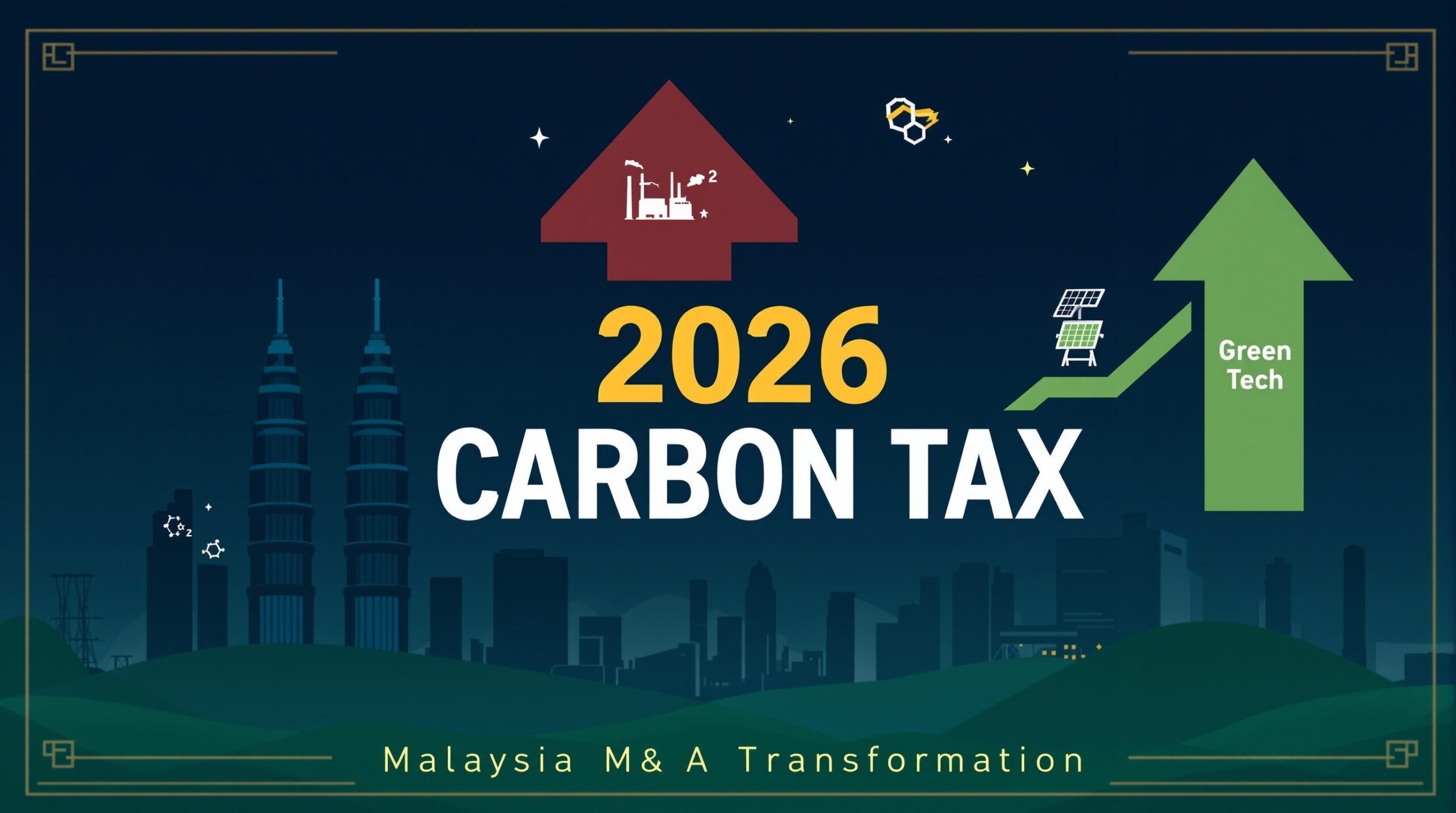
👉 In a nutshell✅ Malaysia will introduce its first full-scale carbon tax in 2026✅ The corporate value of high carbon-emitting companies will fall, accelerating the restructuring of the M&A market✅ Carbon risk assessment will become a mandatory item in due diligence (DD) and contract clauses✅ Demand for acquisitions of renewable energy and energy-saving technology companies will surge, affecting cross-border deals for Japanese companies
Introduction
In November 2025, the Malaysian Parliament passed the 2026 Budget, officially deciding to introduce the country's first full-scale carbon tax system.
The target is high-carbon emitting sectors such as steel and energy.
While I am also supporting M&A deals and renewable energy projects in Malaysia, I have noticed that in recent months an increasing number of business managers are expressing their concerns, asking, "What will happen to my factory when a carbon tax is implemented?"
Even at DD sites, when you ask, "Do you have any emissions data?" you may get answers like, "We don't measure it," or "We know how much electricity we use, but we don't convert it into CO₂."
This carbon tax will not simply be a tax reform, but will be a historic turning point that will fundamentally change the corporate valuation structure and accelerate the restructuring of the M&A market .
In this article, we will organize the impact of the introduction of carbon tax on M&A practices from a practical perspective, focusing on changes in contract clauses, due diligence, and valuation methods.
Carbon tax brings about "redistribution of corporate value"
The carbon tax, which was decided to be introduced in Budget 2026, will have a direct impact on the profit structure of companies through taxation based on carbon emissions.
The impact can be broadly divided into three layers.
[Tier 1] High-carbon emitting companies: rising costs and falling valuations
Companies that consume large amounts of fossil fuels in their manufacturing processes, such as steel, cement, and petrochemicals, will face a direct increase in the burden of the carbon tax.
For example, let's consider the following case.
If a steel factory emits 500,000 tonnes of CO₂ per year and the carbon tax is set at RM50/tCO₂, this will result in an additional cost of RM25 million (approximately 800 million yen) per year.
This burden is not only expected to put pressure on the income statement, but also to result in a decline in the multiple when assessing corporate value using EBITDA multiples .
Even when compared relative to other companies in the same industry, companies that have not made progress in reducing carbon emissions are likely to be shunned by investors, and their stock prices and business value are likely to fall.
[Layer 2] Low-carbon technology companies: Relative value soars
On the other hand, the introduction of a carbon tax will be a tailwind for companies with renewable energy technology, energy-saving solutions, and the ability to generate carbon credits.
Solar power generation companies, biomass energy companies, EMS (energy management system) providers, and others will have new revenue opportunities by "supporting emissions reduction," and buyer demand in the M&A market is expected to surge.
[Third layer] Finance and investors: Tighter ESG standards
Private equity funds and institutional investors are under increasing pressure to disclose the Scope 1 and 2 emissions of their portfolio companies.
After the carbon tax comes into effect, holding high-carbon assets will be seen as a risk, forcing companies to reassess their exit strategies. As a result, quantitative assessment of carbon emissions risk is expected to become a mandatory item in due diligence at the time of acquisition .
Three shifts in M&A strategy
With the introduction of the carbon tax, corporate M&A strategies are expected to shift in three major directions.
Seller: Accelerating carve-out of high-carbon businesses
Companies facing the burden of carbon taxes will likely consider carving out their high-emission business divisions as an option.
For example, a company with multiple manufacturing bases may sell its aging coal-fired power-dependent factories and concentrate its resources on factories that use gas-fired or renewable energy power.
In practice, you may face challenges like this.
・Accounting procedures to accurately measure and allocate carbon emissions from the business to be separated ・Negotiation strategies when the number of potential buyers is limited (competitive bidding vs. bilateral negotiations)
- Isolation of environmental liabilities that remain after the sale (such as litigation risks due to past emissions)
Acquirer: Acquisition of green tech companies and renewable energy assets
Renewable energy and energy-saving technology companies, which were previously considered "peripheral businesses," are now being repositioned as core strategic assets.
As manufacturers rush to decarbonize their factories, we expect to see an increase in acquisitions such as these:
・Acquisition of solar and biomass power generation companies : Converting in-house electricity consumption to renewable energy ・Integration of EMS and IoT companies : Optimizing energy efficiency throughout the factory ・Acquisition of carbon credit development companies : In-house production of emissions offsetting methods
For example:
IOI Corp's 300MW solar power generation plan, which was reported in a newspaper article on November 5, 2025, is a typical example of a plantation company utilizing its land assets to enter the renewable energy business. This trend is likely to lead to the creation of package deals of "land + renewable energy technology" in the M&A market.
PE Fund: Low-carbon investment with exit in mind
PE funds are now actively investing in decarbonization during their investment period, aiming to maximize the valuation of their holdings at the time of their exit (IPO or secondary sale).
in particular…
・Factory fuel conversion (coal → natural gas/biomass)
・Installation of rooftop solar panels ・Acquisition of ISO14001 and ISO50001 certification ・Establishment of Scope 3 emissions management system
This has resulted in a strategy of obtaining an "ESG premium" at the time of exit and aiming to sell at a price above the normal EBITDA multiple.
How M&A contract clauses will change
With the introduction of the carbon tax in mind, it is expected that the design of clauses in M&A-related contracts will also change.
Below are some examples of clauses that are of interest in practice.
■ Representations and Warranties
Traditional:
"The target company complies with all environmental laws and regulations."
This alone is not enough in the carbon tax era.
Evolution type (carbon tax compatible):
"The target company's Scope 1 and 2 emissions for the past three years are as stated in the attached emissions report and have been certified by a third-party verification organization. The expected annual tax burden after the carbon tax is implemented will not exceed RMXX."
In this way, it seems likely that we will move towards specifying specific emissions data and estimated tax burdens .
■ Indemnity clause
The buyer will demand compensation from the seller if the carbon tax burden exceeds the disclosed amount. Conversely, the seller will insist on drawing a line under which any increase in emissions after the acquisition will be the buyer's responsibility.
The focus of the negotiations will be
- The seller will be responsible for any tax burden arising from emissions prior to the closing date. - The buyer will be responsible for any increase in emissions due to operational changes after the acquisition. - A maximum compensation amount will be set when undisclosed emission sources are discovered.
■ Earnout clause
"ESG-linked earn-outs" have also emerged, which link the acquisition price to progress in decarbonization.
for example:
"If the target company reduces its Scope 1 emissions by 30% within two years of the acquisition, we will pay the seller an additional consideration of RM5 million."
This creates an incentive for sellers to cooperate in decarbonization efforts after the acquisition. Although there are still few examples, we believe this will increase in the future.
A new standard in due diligence: carbon risk assessment
Traditionally, M&A DD has focused on four areas: finance, legal, tax, and business. However, after the carbon tax is implemented, "Carbon Due Diligence" is expected to become the fifth essential area .
Key check items for carbon DD
Actual emissions measurement and GHG protocol compliance
・Data for the past three years for Scope 1 (direct emissions) and Scope 2 (electricity-derived) ・Basis for use of emission factors and validity of calculation method ・Whether or not third-party verification has been conducted (e.g., ISO14064-3 compliance)
In fact, it seems quite difficult...
Many small and medium-sized enterprises in Malaysia do not accurately measure and record their Scope 1 and 2 emissions. When asked, "How many liters of fuel do you use?", it is not uncommon to hear the answer, "About this much..."
Quantitative assessment of carbon tax burden
・Estimate annual tax burden by multiplying current emissions by the tax rate ・Analysis of future tax rate hike scenarios (RM50 → RM100/tCO₂, etc.)
・Can carbon taxes be passed on to product costs? (Check contract terms with customers)
Whether or not the tax burden can be passed on to product prices depends greatly on the business model.
For B2B manufacturing companies, a key point is whether existing supply contracts include a "carbon tax price pass-through clause."
Savings Plan and CapEx Estimates
・Examination of the feasibility of the decarbonization roadmap already formulated by the target company ・CapEx required for equipment renewal and fuel conversion ・Calculation of the present value of the future tax burden reduction effect due to reduction
When asked, "Do you have a decarbonization roadmap?", it is likely that in many cases companies will respond with, "It's written in the ESG report, but where's the specific budget..." and therefore it is thought that measures are needed.
Regulatory and litigation risks
-Whether or not there have been any past violations of the emissions reporting obligation -Validity of carbon credit purchase contracts (credit risk of the contracting party)
- Whether climate change-related lawsuits are pending (future compensation risk)
Practical Issues: Calculating Estimated Emissions
The most difficult part of the DD process is dealing with cases where emissions data does not exist .
In this case, we will work backwards from the factory's fuel and electricity consumption to make conservative estimates of emissions, and then reflect this in the transaction price and design compensation clauses.
Malaysian renewable energy company M&A trends
The newspaper article reports on the following corporate trends:
Wasco Greenergy: Plans for IPO this year
Wasco Greenergy, which is primarily engaged in the construction and operation of biomass and steam power generation facilities, is aiming to list on the main market with CIMB and Maybank as lead managers. The company plans to use the proceeds from the IPO to expand its business in Indonesia and invest in R&D.
M&A highlights:
・Expansion of secondary acquisition opportunities for PE funds and operating companies after listing ・Status of response to sustainability reporting obligations (Bursa Malaysia requirements) in IPO prospectuses ・Disclosure of related party transactions and development of governance
IPOs of renewable energy companies are attracting attention from investors as "investment opportunities in the decarbonization trend," and similar cases are expected to continue in the future.
Orkim: Partial Exit from State Investment Company Ekuinas
Oil tanker operator Orkim will sell part of its stake in Ekuinas in the IPO, although Ekuinas will retain a 60% stake after the listing.
How do you view this movement?
Government-affiliated funds are adopting a strategy of "ensuring liquidity and retaining management rights" rather than a complete exit. This is seen as a sign of their stance of not letting go of shipping and logistics infrastructure as a strategic asset, and it is likely that IPOs following a similar pattern will continue in the future.
Implications for Japanese companies and cross-border M&A
When Japanese companies consider acquiring Malaysian companies or establishing joint ventures, the implementation of the carbon tax is expected to have the following effects:
Reevaluating acquisition targets
Malaysia's manufacturing industry, which has traditionally been valued for its "cheap labor force and strategic location," will increasingly face "hidden costs" due to the carbon tax burden.
It will likely be essential to conduct carbon due diligence before acquisitions and to incorporate tax burdens into valuations.
Allocation of carbon tax burden in JV contracts
When a Japanese company forms a joint venture with a local partner, it must clearly state in the contract who will bear the carbon tax.
In particular, in cases where an existing factory is contributed in kind, the treatment of tax burdens resulting from past emissions becomes a point of contention.
We believe that clauses such as "carbon tax on existing facilities will be borne by local partners" and "new investments will be apportioned based on investment ratios" will be required.
Opportunities to enter the renewable energy business
Conversely, this is also a great opportunity for Japanese companies to locally deploy their energy-saving technologies and renewable energy facilities.
There is potential to expand our decarbonization support business through technical partnerships, licensing, and equipment delivery with Malaysian companies.
Our support area: M&A practices in the era of carbon tax
At Borderless Consulting, we leverage our practical experience in renewable energy and M&A, as well as our local networks, to provide the following support:
■ Carbon DD Support
Working with local experts, we will:
・Measurement and verification support for Scope 1 and 2 emissions ・Carbon tax burden scenario analysis and valuation adjustment ・Collaboration with third-party verification organizations (ISO14064-3 certification organizations, etc.)
Even if you don't have any emissions data, you can calculate estimated emissions from fuel and electricity consumption and reflect them in your DD report.
■ Designing M&A contract clauses
・Drafting representations and warranties and indemnification clauses related to carbon taxes ・Designing ESG-linked earn-out clauses ・Clarifying governing law and dispute resolution clauses in cross-border transactions
We support both English and Malaysian law-based contracts, and incorporate carbon risk clauses appropriately.
■ ESG consulting after integration
・Formulation of decarbonization roadmap after acquisition ・Feasibility study for renewable energy introduction ・Support for sustainability reporting for companies listed on Bursa Malaysia
We provide one-stop support for post-merger integration (PMI) after M&A is completed, right up to the establishment of an ESG system.
■ Matching renewable energy and technology partners
・Partnership with solar and biomass businesses ・Introduction to EMS and IoT solution providers ・Support for access to the carbon credit trading market
We utilize our local network to help you find reliable partner companies.
Summary – 3 steps you can take now
There isn't much time left until the carbon tax is introduced in 2026.
The M&A market will be restructured around "carbon." As the value of high-carbon companies declines and the value of low-carbon companies rises simultaneously, companies are expected to be forced to make decisions about whether to sell, acquire, or merge .
I think there are three things we can do now:
✅ Step 1 – Understand your own (or your potential acquisition's) emissions
First, start by understanding the current situation.
We believe that measuring Scope 1 and 2 emissions can be completed in a few weeks to a few months with expert assistance.
✅ Step 2 – Conduct a scenario analysis of carbon tax burdens
We estimate the impact of tax rate fluctuations and incorporate this into our business plans.
If you are considering M&A, this will also need to be reflected in your valuation.
✅ Step 3 – Incorporate carbon risk clauses into M&A and JV agreements
We will review existing contract templates and incorporate carbon-related clauses into representations, warranties, indemnification and earn-out clauses.
In the future, as I work on M&A projects in Malaysia, I expect to hear many people asking, "What should we do about carbon tax?"
Some details of the system have yet to be finalized, which is why we believe it is important to start preparations early.
At Borderless Consulting, we leverage our deep understanding of local systems and cutting-edge experience in renewable energy and M&A to support our clients in their strategic decision-making.
If you have any questions or concerns, please feel free to contact us.
- [Column Writing] 【ESG Strategies Useful for Business】The 25th Green Power System
- [Column] Seven pitfalls to face in cross-border M&A
Related articles
-
 [Column Writing] 【 ESG Strategies for Business 】36th Malaysia's EPR Mandatory Packaging and Single-Use Plastic Regulations— Current Location of the Plastic Sustainability Roadmap
 -
[Column] Will Vietnam be the next Thailand – Footsteps of low birth rates and talent shortages
-
[Column] Can Japanese Hydroelectric Technology Be Used Abroad – From "Building" Power Plants to "Using them for a Long Time"
-
[Column] Can a corrupt country grow its economy – Quality of growth from the Philippines
-
[Column Writing] 【ESG Strategies for Business 】35th Malaysian PDPA Revision and Practical Responses for Japanese Companies— Guidelines for DPO Appointment, Disclosure Notification, and Cross-Border Data Transfer
-
[Column] Will Vietnam change ASEAN's growth pecking order. Semiconductor and human resource development advance the industry
-
[Column] Why Malaysia's semiconductor industry is being reevaluated now. Current location as the center of ASEAN restructuring
-
【Announcement 】 First report published as JETRO Platform Coordinator