[Column] Malaysia CRESS Complete Guide – Turning Point in Power Procurement Strategy for Manufacturing
✅ Roughly speaking
- ⚡ CRESS system access fees to be reduced by up to 40% in August 2025 : Farm-supplied SAC reaches 20 sen/kWh , emerging as a viable option for 24-hour factories
- 🔄 Structural transformation of the electricity market through third-party access (TPA) : Moving away from TNB's single-buyer model, a system that allows companies to enter into direct PPAs with power generation companies has begun in earnest
- 📊 Strategic selection of four renewable energy procurement schemes is needed Understanding the characteristics of CRESS, GET Greenpath, CGPP, NEM/LSS, and building an optimal portfolio according to the company's load patterns and contract risk tolerance are the sources of competitive advantage
- 🚀 The key to success of projects with storage batteries : Farm-supplied power generation partner search and hedging of energy costs with long-term fixed prices improve the foreseeability of business plans
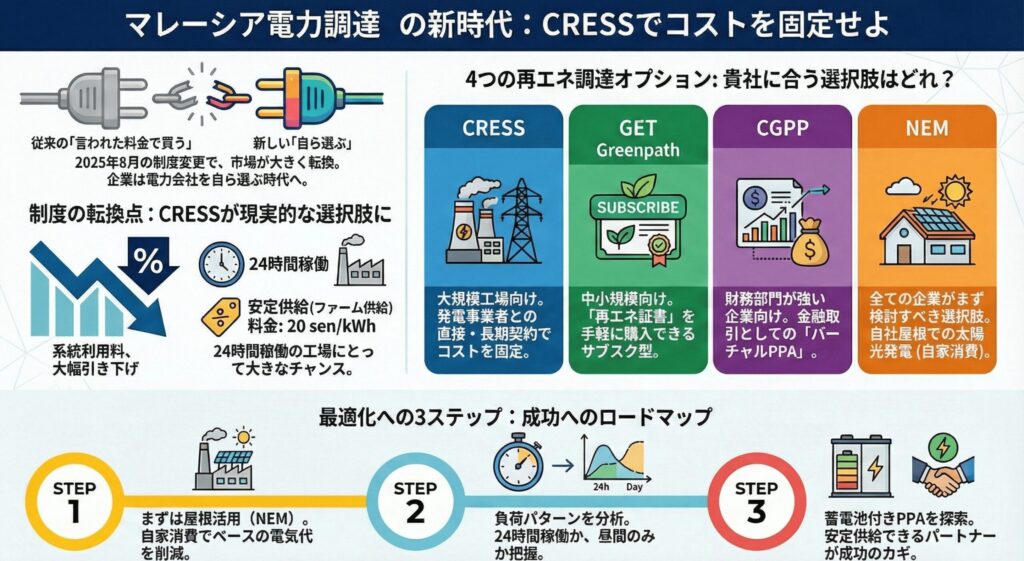
table of contents
Introduction
This marks a major turning point for Malaysian manufacturing companies in the second half of 2025 CRESS (Corporate Renewable Energy Supply Scheme) We will explain.
Malaysia's electricity market has operated for many years under the exclusive single-buyer model of TNB (Tenaga Nasional).
When companies tried to source renewable energy (hereinafter "renewable energy"), they had no choice but to select the menu provided by TNB (e.g., GET) or install solar panels on their roofs (NEM).
However, A new regulatory period called RP4 (Regulatory Period 4) will begin in July 2025 , the structure of industrial electricity prices has been revamped.
Furthermore In August, the government announced a reduction of up to 40% in CRESS's System Access Charge (SAC) and the tide of the market has turned very much.
For manufacturing companies facing the dilemma of "we want to decarbonize, but we can't raise costs any further," could CRESS be a lifesaver, or would traditional TNB power purchases or existing green power programs be more sensible.
This paper explores Malaysia's increasingly complex renewable energy procurement options A thorough comparison from the perspective of "cost" and "risk hedging" I will.
What is CRESS: Institutional Structure and Innovation
Basic structure of the Malaysian electricity market
Malaysia's electricity market has traditionally operated in the following structure:
Power generation companies (IPPs, etc.) ↓
TNB (Single Buyer) ↓
General transmission and distribution company (TNB's grid division) ↓
Demanders (factories, offices, etc.)
This "single buyer model" consisted of all generators selling electricity to TNB, which then supplied it to the demanders in bulk.
Demanders had no choice but to pay regulated fees (tariffs) determined by TNB.
CRESS introduces "Third Party Access (TPA)"
CRESS broke this structure and introduced a mechanism that allowed companies to source electricity directly from generators. Specifically, the process goes as follows:
Power Generation Operator (IPP) ↓ [PPA Contract] ↓
General transmission and distribution company system (physical transmission grid) ↓ [System usage fee: SAC payment] ↓
Demanders (corporate factories)
This is Third Party Access (TPA) This is a system called "borrowing" electricity from the grid, with generators and demanders signing direct contracts.
Legal requirements and contract structure for CRESS
CRESS requires three contracts: The Committee recommends that the State party take all necessary measures to ensure that all children are provided with adequate and adequate housing, adequate housing, adequate housing, adequate housing, adequate housing, adequate housing, adequate housing, adequate housing, and adequate housing.
PPA (Power Purchase Agreement)
- Conclusion between power generators and demanders
- Prescribes the unit price of electricity, contract period (usually 10~20 years), payment terms, etc
System Access Agreement (System Access Agreement)
- concluded between the demander and the general transmission and distribution operator
- Prescribes power grid usage fees (SACs) and technical requirements
Metering and Settlement Agreement (Metering and Settlement Agreement)
- Regulations regarding electricity quantity metering methods and payment procedures
Through these agreements, companies Long-term fixed-price electricity procurement not bound by TNB's regulated tariffs This will enable us to achieve the following.
SAC cuts in August 2025: What's changed
What is SAC (System Access Fee)
When CRESS was first introduced, the biggest concern was that the grid charge (SAC) would be too high and unprofitable.
SAC is the fee paid to general transmission and distribution operators when sending electricity from a generator to a demander.
This SAC is divided into two sections based on security of supply.
Farm Supply (Firm Supply)
- When a battery (BESS: Battery Energy Storage System) is installed and electricity is transmitted stably
- Solar power generation + storage battery-like configuration
Non-Firm Supply (Non-Firm Supply)
- When power generation varies depending on the weather, such as sunlight only
- Supply may be cut off during cloudy weather or at night
August 2025 Rate Revision: Dramatic Lowering
The Ministry of Energy Transition and Water Transformation (PETRA) on August 29, 2025, lowered the SAC to: The Committee recommends that the State party take all necessary measures to ensure that all children are provided with adequate and adequate housing, adequate housing, adequate housing, adequate housing, adequate housing, adequate housing, adequate housing, adequate housing, and adequate housing.
| distinguish | Old Rate | New Rate (August 2025~) | Reduction width |
|---|---|---|---|
| Farm Supply | 25 sen/kWh | 20 sen/kWh | 20% less |
| Nonfarm supply | 45 sen/kWh | 40 sen/kWh | 11% decrease |
Why this reduction is important
With farm-supplied SAC now down to 20 sen/kWh, CRESS has emerged as a viable option for 24-hour factories.
Meanwhile, "non-farm supply" without batteries remains expensive at 40 sen/kWh.
That is, "If you want to use CRESS, choose a project with a storage battery." This is likely the message of the current market.
Comparison of four renewable energy procurement schemes
There are four main options for manufacturing to source renewable energy in Malaysia:
CRESS (RE Supply Scheme for Companies)
How it works
This is a system that connects the power generator directly with the PPA and physically sends electricity.
Cost structure
[PPA Price] + [SAC] + [Other Line-Related Expenses]Companies that are suitable for
- Large-scale factories (especially medium-voltage and high-voltage power receiving)
- Companies looking to hedge against rising fuel costs and carbon tax risks in 2026 and beyond
- Companies that are required to procure renewable energy with "additionality" in RE100, etc
Benefits
Renewable Energy Fund (KWTBB: 1.6%) payments will be waived from August 1, 2025 The Committee recommends that the State party take all necessary measures to ensure that all children are provided with adequate and adequate housing, adequate housing, adequate housing, adequate housing, adequate housing, adequate housing, adequate housing, adequate housing, and adequate housing.
Legal requirements for CRESS
- Demanders need power generation equipment with a minimum capacity of 30MW or more and high-voltage direct connections
- Power generation facilities are newly established or located within Malaysia
- Long-term contracts, usually 10~20 years in duration
GET Greenpath (New Green Power Tarif)
How it works
A subscription that includes a "Malaysian Renewable Energy Certificate" (mREC) for electricity purchased from TNB It is. It was renewed in July 2025.
Cost structure
[Normal electricity bill] + [Greenpath surcharge]Points to note
Unlike the previous GET, The exemption for fuel adjustment costs (AFA/ICPT) is no longer available. This means that as fossil fuel prices rise, so do electricity bills.
Companies that are suitable for
Small and medium-sized factories and offices. It is considered suitable for those who want to easily increase their renewable energy ratio but do not want to take the risk of long-term contracts.
CGPP (Corporate Green Power Program)
How it works
Cost structure
Complex accounting procedures are required (even when dealing with derivatives). It does not incur physical transmission costs (SAC), but only receives a renewable energy certificate.
Companies that are suitable for
It seems suitable for multinational companies with strong financial sectors that can use renewable energy as a financial hedging tool.
LSS (Large-Scale Solar Power Generation) / NEM (Net Energy Metering)
How it works
- LSS : Basically for selling electricity to TNB
- NEM : Installed on the roof of our own factory for self-consumption
Companies that are suitable for
First of all, NEM (roof-mounted) is the top priority. It is considered to be the option with the most cost benefits (as it allows you to buy less from TNB). CRESS will be positioned as the next step.
Cost comparison thinking: which is better
Structural changes in industrial electricity prices in RP4
RP4, which began in July 2025, significantly restructured industrial electricity prices The Committee recommends that the State party take all necessary measures to ensure that all children are provided with adequate and adequate housing, adequate housing, adequate housing, adequate housing, adequate housing, adequate housing, adequate housing, adequate housing, and adequate housing.
The classification has been changed from the previous classification by industry (commercial, industrial, etc.) to classification by voltage level (low voltage, medium voltage, high voltage).
Changes in the reference tariff
- RP3 (2022~2024): 39.95 sen/kWh
- RP4 (July 2025~December 2027): 45.40 sen/kWh
- Increase rate: Approximately 13.6%
Four-factor pricing structure
Electricity price = Energy price + Capacity price + System price + Retail priceThis restructuring will have a very different impact on tariffs from one company to another, depending on voltage levels and usage patterns.
Cost-benefit study of CRESS implementation
When assessing the economics of CRESS, the following factors must be considered together:
Cost elements
CRESS Total Cost = [PPA Price] + [SAC 20 sen/kWh (Farm Supply)] + [Other System Costs]Comparison elements with TNB standard tariff
- Current RP4 standard tariff (45.40 sen/kWh)
- Risk of future fuel cost adjustments (AFAs)
- Benefits of the KWTBB (1.6%) exemption
Important points to note
Actual cost benefits vary widely depending on the following individual factors:
- PPA prices offered by power generators (often with private market information)
- Factory power consumption patterns (24-hour operation vs. daytime only, etc.)
- Contract duration (10 years vs. 20 years)
- Future fuel price projections
Therefore, It is not possible to say with a blanket certainty that "CRESS is cheaper" or "TNB is cheaper." Individual case studies and expert simulations are required.
Risk factors in long-term contracts
CRESS Risk
- Creditworthiness of power generators (bankruptcy risk)
- Deterioration of storage batteries reduces supply stability
- Changes in the grid connection conditions during the contract period
- Loss of flexibility due to long-term contracts
Risk of TNB standard tariff
- Rising fuel prices
- Possible future regulatory changes
- Additional costs of stronger environmental regulations
Three steps towards implementation
CRESS is not a "one size fits all" system, but when implemented properly it can be a powerful weapon.
Step 1: Maximize Roof Utilization (NEM)
First of all Power generation on own roof (Solar SELCO/NEM) So, lowering your base electricity bill is a priority.
How NEM (Net Energy Metering) works
- Solar panels installed on our own roof
- Daytime excess power flows countercurrent to the TNB grid
- At night, we purchase electricity from TNB
- Monthly deductions to settle electricity bills
Benefits of NEM
- Relatively little initial investment
- Short payback period (usually 5~7 years)
- You can directly reduce the amount of electricity you buy from TNB
Step 2: Analyze load patterns
Whether your company's electricity consumption is flat 24 hours a day or only during the day.
To receive CRESS "farm supply" , a stable demand curve is advantageous.
Classification of load patterns
Type A: 24-hour flat type
- Semiconductor factories, data centers, etc
- Compatible with farm supply Type B: Daytime peak type
- Assembly factories, logistics warehouses, etc
- Non-farm supply available (but at a higher cost) Type C: Nighttime peak type
- Some manufacturing industries
- Farm supply required (not compatible with solar alone)
Step 3: Explore "PPA with Battery"
The key to benefiting from CRESS is finding a power generation partner that can accommodate SAC's cheap "farm supply" The Committee recommends that the State party take all necessary measures to ensure that all children are provided with adequate and adequate housing, adequate housing, adequate housing, adequate housing, adequate housing, adequate housing, adequate housing, adequate housing, and adequate housing.
Power Generation Partner Selection Checklist
- [ ] Does it have a storage battery (BESS)
- [ ] Do you have a track record in Malaysia
- [ ] Are your financial situation sound (can you survive a 20-year contract)
- [ ] Is the O&M (operation and maintenance) system established
- [ ] Is insurance coverage sufficient (natural disasters, equipment breakdowns, etc.)
International comparison: Institutional differences with Japan and ASEAN
Comparison with Japanese corporate PPAs
In Japan, there is a complex regulatory system under the Electricity Business Act, and the following schemes exist.
Japanese PPA scheme
- On-site PPA (on company premises)
- Offsite PPA (via retail electricity providers)
- Self-commitment (close relationship requirements apply)
- Virtual PPA (Price Difference Settlement)
Differences from Malaysia CRESS
- In Japan, it is essential that retail electricity companies be involved
- Malaysia allows direct contracts between power producers and consumers
- Japan has strict requirements for "close ties" for self-consignment
- Malaysia can also contract with power producers outside the corporate group
Comparison with ASEAN countries
Singapore
- Full liberalisation of the electricity retail market from 2018
- Businesses can choose from multiple retailers
- However, the country is small, limiting the suitable areas for off-site sunlight
Thailand
- PPA system in development
- The influence of the national electricity corporation (EGAT) remains strong
- Limited renewable energy procurement for businesses
Vietnam
- Direct PPA (DPPA) system to be introduced in 2021
- However, the procedure is complicated and there are few examples
- Frequent delays in grid connection
Position of Malaysia CRESS
Within ASEAN, it can be assessed as a relatively advanced renewable energy procurement system for companies. In particular, it is characterized by the transparency and predictability of the SAC.
summary
Malaysia's electricity market has entered a period of transition away from a single-buyer model.
Since the days of "paying what you're told," The era of "choosing your own power source and fixing costs" The transition to is beginning.
CRESS is considered a viable option for companies that:
Characteristics of companies where CRESS implementation is effective
- Large annual power consumption (multiple MW scale)
- 24-hour operation or stable load pattern
- Long-term business continuity is expected
- I want to hedge against the risk of rising fuel costs
- Needs to respond to international environmental initiatives such as RE100
On the other hand, traditional GET Greenpath and NEM seem more suitable for companies such as:
Characteristics of companies other than CRESS that are suitable for
- Small annual electricity consumption
- Large load fluctuations (large difference between peak and off-peak hours)
- I want to emphasize short-term flexibility
- I don't want to risk a long-term contract
The importance of optimal portfolio construction
In practice, Combining multiple schemes rather than relying on a single scheme It is recommended that.
【Recommended portfolio example 】
1.  NEM (Roofed): 30% → Highest cost benefit 2.  CRESS (farm supply): 50% → hedging with long-term price fixing 3.  TNB Standard Tarif: 20% → Ensure flexibility
In uncertain times, restructuring energy strategies with an "aggressive" attitude is likely to be a source of competitive advantage.
At Borderless, we offer a consistent range of services, from developing renewable energy procurement strategies in the ASEAN region, including Malaysia, to supporting the selection of power generation partners and contract negotiation support.
- [Column Writing] 【ESG Strategies for Business】 No. 27 Carbon Tax (1)
- [Introducing Investment Projects] Seeking JV Partners for Plant Factory and Hydroponic Cultivation Business in Malaysia
Related articles
-
 [Column] Will Vietnam be the next Thailand – Footsteps of low birth rates and talent shortages
 -
[Column] Can Japanese Hydroelectric Technology Be Used Abroad – From "Building" Power Plants to "Using them for a Long Time"
-
[Column] Can a corrupt country grow its economy – Quality of growth from the Philippines
-
[Column Writing] 【ESG Strategies for Business 】35th Malaysian PDPA Revision and Practical Responses for Japanese Companies— Guidelines for DPO Appointment, Disclosure Notification, and Cross-Border Data Transfer
-
[Column] Will Vietnam change ASEAN's growth pecking order. Semiconductor and human resource development advance the industry
-
[Column] Why Malaysia's semiconductor industry is being reevaluated now. Current location as the center of ASEAN restructuring
-
【Announcement 】 First report published as JETRO Platform Coordinator
-
[Column] Commonalities among companies that fail in emerging markets. How to go beyond ordering products, entrusting agencies, and managing employees